Ch.10 - Gases: Their Properties & Behavior
McMurry - Chemistry 8th Edition
McMurry8th EditionChemistryISBN: 9781292336145당신이 사용하는 게 아니라요?교과서 변경
10장, 문제 48d

Assume that you have a cylinder with a movable piston. What would happen to the gas pressure inside the cylinder if you were to do the following? (d) Halve the Kelvin temperature and triple the volume

검증된 단계별 안내
1
Step 1: Understand the relationship between pressure, volume, and temperature in a gas. This relationship is described by the ideal gas law, which is PV = nRT, where P is the pressure, V is the volume, n is the number of moles of gas, R is the ideal gas constant, and T is the temperature in Kelvin.
Step 2: In this problem, we are changing the volume and the temperature, but the number of moles of gas and the ideal gas constant remain the same. Therefore, we can write the relationship as P1V1/T1 = P2V2/T2, where the subscripts 1 and 2 refer to the initial and final states, respectively.
Step 3: We are told that the final volume is three times the initial volume (V2 = 3V1) and the final temperature is half the initial temperature (T2 = 0.5T1). Substitute these values into the equation from step 2.
Step 4: After substitution, the equation becomes P1V1/T1 = P2*(3V1)/(0.5T1). Simplify this equation to find the relationship between the initial and final pressures.
Step 5: From the simplified equation, you can see that the final pressure is related to the initial pressure, volume, and temperature changes. Solve for P2 to find the final pressure of the gas in the cylinder.

비슷한 문제에 대한 검증된 영상 답변:

이 영상 해법은 위 문제에 도움이 된다고 튜터들이 추천한 것입니다.
영상 길이:
2m

주요 개념

질문에 올바르게 답하기 위해 반드시 이해해야 하는 핵심 개념들은 다음과 같습니다.

Ideal Gas Law

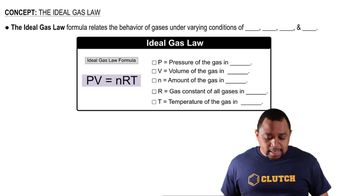
The Ideal Gas Law is a fundamental equation in chemistry that relates the pressure, volume, temperature, and number of moles of a gas. It is expressed as PV = nRT, where P is pressure, V is volume, n is the number of moles, R is the ideal gas constant, and T is the absolute temperature in Kelvin. Understanding this relationship is crucial for predicting how changes in one variable affect the others.
추천 영상:
가이드 코스
01:15
Ideal Gas Law Formula

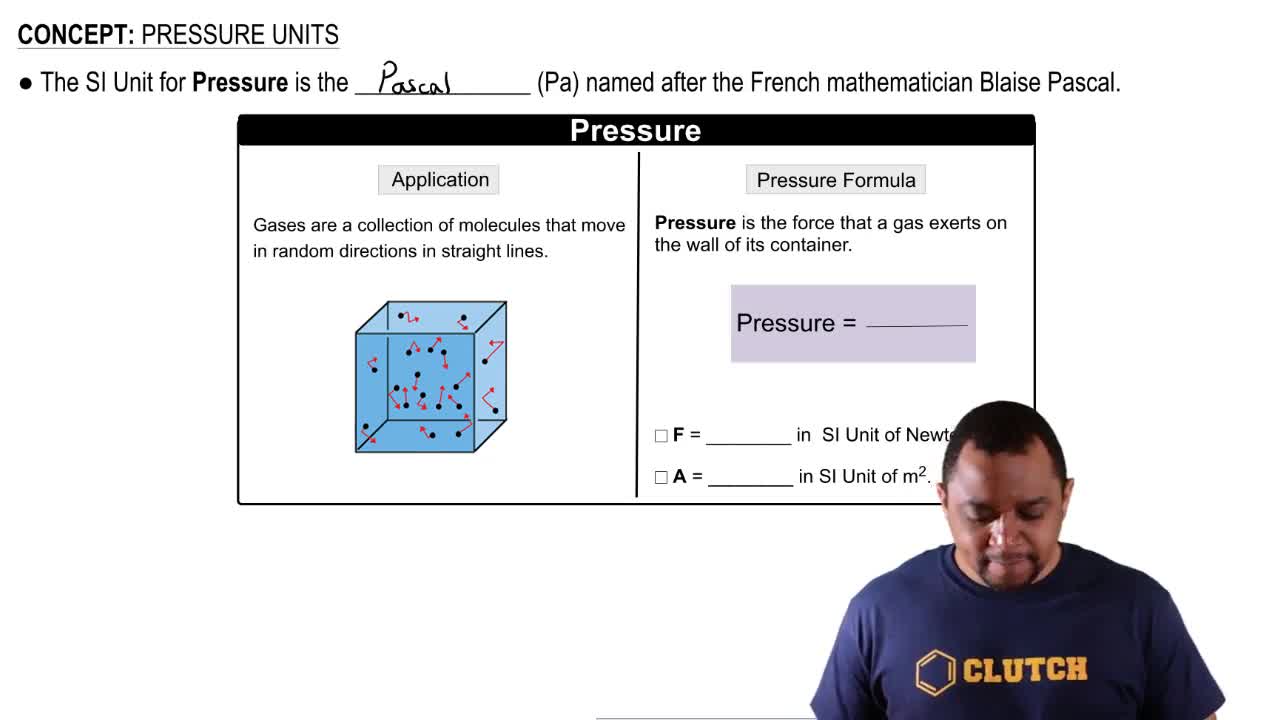
Gas Pressure

Gas pressure is defined as the force exerted by gas molecules colliding with the walls of their container. It is influenced by the number of gas particles, their temperature, and the volume of the container. When the volume increases or the temperature decreases, the pressure typically decreases, as fewer collisions occur against the walls.
추천 영상:

Temperature in Kelvin

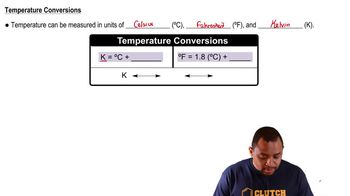
Temperature in Kelvin is the absolute temperature scale used in scientific calculations, where 0 K represents absolute zero, the point at which molecular motion ceases. In gas laws, temperature must be expressed in Kelvin to ensure direct proportionality with pressure and volume. Halving the Kelvin temperature significantly impacts gas behavior, as it indicates a decrease in kinetic energy of the gas molecules.
추천 영상:
가이드 코스
02:03
Temperature Conversion Formulas