Ch.10 - Gases: Their Properties & Behavior
McMurry - Chemistry 8th Edition
McMurry8th EditionChemistryISBN: 9781292336145당신이 사용하는 게 아니라요?교과서 변경
10장, 문제 52

Oxygen gas is commonly sold in 49.0-L steel containers at a pressure of 150 atm. What volume in liters would the gas occupy at a pressure of 1.02 atm if its temperature remained unchanged? If its temperature was raised from 20 °C to 35 °C at constant P = 150 atm?

검증된 단계별 안내
1
Step 1: Identify the initial and final conditions for the first part of the problem. The initial volume (V1) is 49.0 L, and the initial pressure (P1) is 150 atm. The final pressure (P2) is 1.02 atm, and we need to find the final volume (V2) at constant temperature.
Step 2: Use Boyle's Law for the first part, which states that for a given amount of gas at constant temperature, the product of pressure and volume is constant: P1 * V1 = P2 * V2. Rearrange this equation to solve for V2: V2 = (P1 * V1) / P2.
Step 3: For the second part of the problem, identify the initial and final temperatures. The initial temperature (T1) is 20 °C, which needs to be converted to Kelvin by adding 273.15. The final temperature (T2) is 35 °C, also converted to Kelvin.
Step 4: Use Charles's Law for the second part, which states that for a given amount of gas at constant pressure, the volume is directly proportional to its temperature: V1 / T1 = V2 / T2. Rearrange this equation to solve for V2: V2 = V1 * (T2 / T1).
Step 5: Calculate the final volume for each scenario using the respective equations derived in steps 2 and 4, ensuring all units are consistent.

주요 개념

질문에 올바르게 답하기 위해 반드시 이해해야 하는 핵심 개념들은 다음과 같습니다.

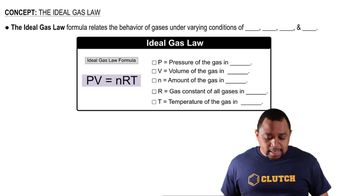
Ideal Gas Law

The Ideal Gas Law relates the pressure, volume, temperature, and number of moles of a gas through the equation PV = nRT. This law is essential for understanding how gases behave under varying conditions. In this question, it helps determine the new volume of oxygen gas when the pressure changes while keeping the temperature constant.
추천 영상:
가이드 코스
01:15
Ideal Gas Law Formula

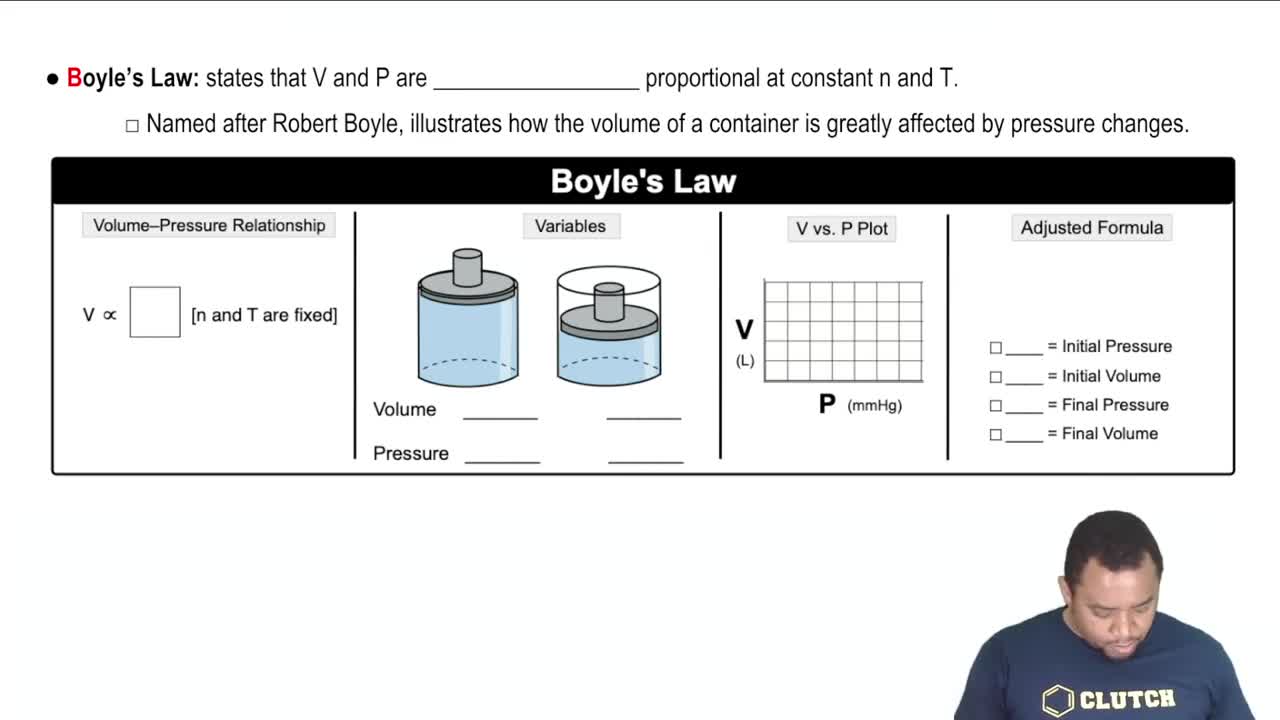
Boyle's Law

Boyle's Law states that the pressure of a gas is inversely proportional to its volume when temperature and the number of moles are held constant (P1V1 = P2V2). This principle is crucial for solving the first part of the question, where the volume of gas at a lower pressure is calculated while maintaining a constant temperature.
추천 영상:

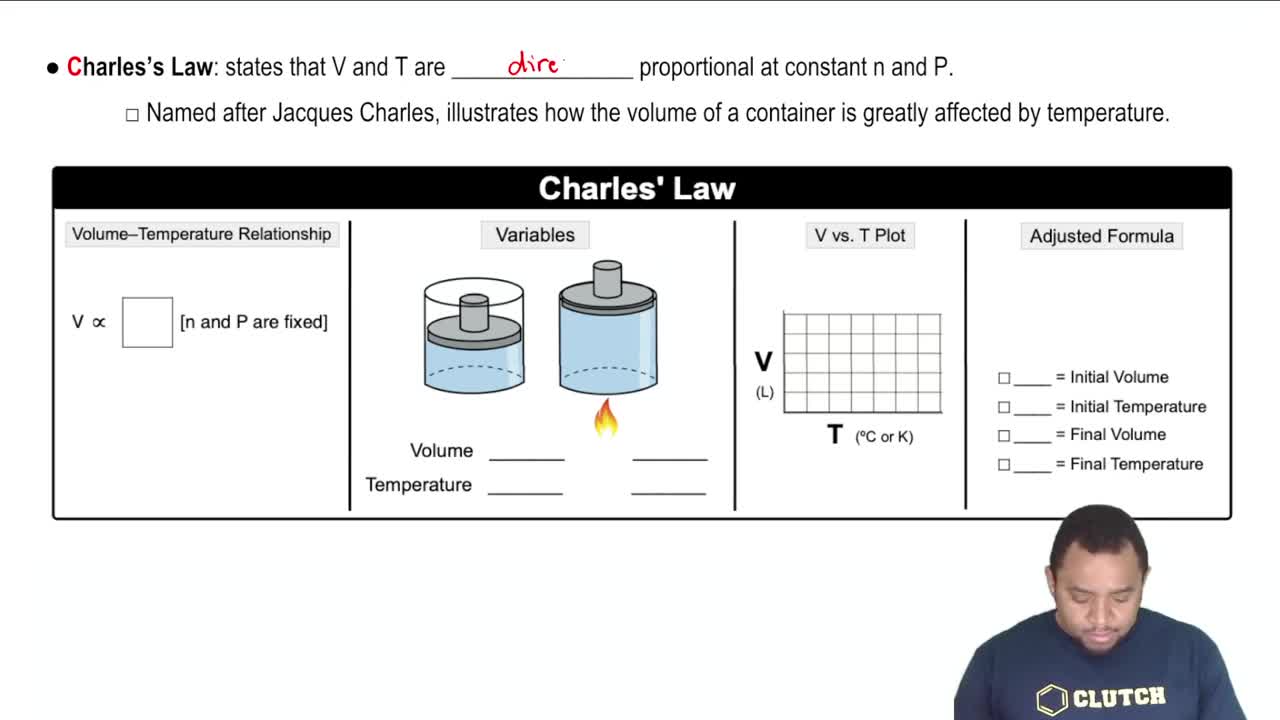
Charles's Law

Charles's Law states that the volume of a gas is directly proportional to its temperature (in Kelvin) when pressure is held constant (V1/T1 = V2/T2). This law is relevant for the second part of the question, where the volume change of the gas is analyzed due to an increase in temperature at constant pressure.
추천 영상: