Ch.10 - Gases: Their Properties & Behavior
McMurry - Chemistry 8th Edition
McMurry8th EditionChemistryISBN: 9781292336145당신이 사용하는 게 아니라요?교과서 변경
10장, 문제 51

Which sample contains more molecules: 2.50 L of air at 50 °C and 750 mm Hg pressure or 2.16 L of CO2 at -10 °C and 765 mm Hg pressure?

검증된 단계별 안내
1
Step 1: Use the Ideal Gas Law, PV = nRT, to find the number of moles (n) for each gas sample. Remember that P is pressure, V is volume, n is the number of moles, R is the ideal gas constant, and T is temperature in Kelvin.
Step 2: Convert the given temperatures from Celsius to Kelvin by adding 273.15 to each temperature. For the air sample, T = 50 + 273.15 K. For the CO2 sample, T = -10 + 273.15 K.
Step 3: Convert the pressures from mm Hg to atm, since the ideal gas constant R is typically given in L·atm/(mol·K). Use the conversion factor: 1 atm = 760 mm Hg. For the air sample, P = 750 mm Hg. For the CO2 sample, P = 765 mm Hg.
Step 4: Substitute the values for P, V, and T into the Ideal Gas Law equation for each sample to solve for n (number of moles). Use R = 0.0821 L·atm/(mol·K).
Step 5: Compare the number of moles calculated for each sample. The sample with the greater number of moles contains more molecules, as the number of molecules is directly proportional to the number of moles.

주요 개념

질문에 올바르게 답하기 위해 반드시 이해해야 하는 핵심 개념들은 다음과 같습니다.

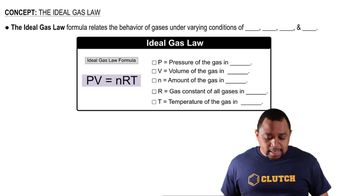
Ideal Gas Law

The Ideal Gas Law relates the pressure, volume, temperature, and number of moles of a gas through the equation PV = nRT. Here, P is pressure, V is volume, n is the number of moles, R is the ideal gas constant, and T is temperature in Kelvin. This law allows us to calculate the number of molecules in a gas sample by rearranging the equation to find n, which is directly proportional to the number of molecules.
추천 영상:
가이드 코스
01:15
Ideal Gas Law Formula

Molar Volume of a Gas

At standard temperature and pressure (STP), one mole of an ideal gas occupies approximately 22.4 liters. However, the volume occupied by a gas can change with temperature and pressure. Understanding how to convert conditions to STP or use the Ideal Gas Law is essential for comparing the number of molecules in different gas samples under varying conditions.
추천 영상:
가이드 코스
00:51
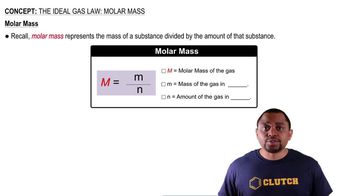
The Ideal Gas Law: Molar Mass

Temperature and Pressure Effects on Gas Behavior

Temperature and pressure significantly affect gas behavior, influencing the volume and number of molecules present. Higher temperatures increase kinetic energy, leading to greater volume if pressure is constant, while higher pressure compresses gas into a smaller volume. Recognizing how these factors interact is crucial for accurately determining the number of molecules in different gas samples.
추천 영상:
가이드 코스
01:08
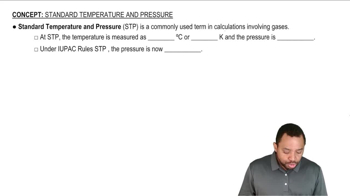
Standard Temperature and Pressure