
Ch.10 - Gases: Their Properties & Behavior
McMurry - Chemistry 8th Edition
McMurry8th EditionChemistryISBN: 9781292336145당신이 사용하는 게 아니라요?교과서 변경
10장, 문제 137a

The apparatus shown consists of three temperature-jacketed 1.000-L bulbs connected by stopcocks. Bulb A contains a mixture of H2O(g), CO2(g), and N2(g) at 25 °C and a total pressure of 564 mm Hg. Bulb B is empty and is held at a temperature of -70 °C. Bulb C is also empty and is held at a temperature of -190 °C. The stopcocks are closed, and the volume of the lines connecting the bulbs is zero. CO2 sublimes at -78 °C, and N2 boils at -196 °C.
(a) The stopcock between A and B is opened, and the system is allowed to come to equilibrium. The pressure in A and B is now 219 mm Hg. What do bulbs A and B contain?

검증된 단계별 안내
1
Identify the physical states of the gases at the given temperatures. Since CO2 sublimes at -78 °C and the temperature in Bulb B is -70 °C, CO2 will remain as a solid in Bulb A and will not transfer to Bulb B. N2 boils at -196 °C, so it remains as a gas at -70 °C and can transfer to Bulb B.
Consider the behavior of H2O(g). Water vapor can condense at temperatures below 100 °C, and since Bulb B is at -70 °C, H2O will likely condense when it enters Bulb B.
Calculate the partial pressures of the gases that can transfer to Bulb B. Since the total initial pressure in Bulb A is 564 mm Hg and the pressure after equilibrium is 219 mm Hg, the gases that transferred must account for the difference in pressure.
Determine the composition of gases in Bulb A after equilibrium. Since CO2 does not sublime at -70 °C, it remains in Bulb A. The remaining pressure in Bulb A is due to the partial pressures of CO2 and any residual H2O(g) or N2(g) that did not transfer.
Conclude what Bulbs A and B contain after equilibrium. Bulb A will contain CO2(s) and possibly some residual H2O(g) and N2(g), while Bulb B will contain condensed H2O and N2(g).

비슷한 문제에 대한 검증된 영상 답변:

이 영상 해법은 위 문제에 도움이 된다고 튜터들이 추천한 것입니다.
영상 길이:
4m

주요 개념

질문에 올바르게 답하기 위해 반드시 이해해야 하는 핵심 개념들은 다음과 같습니다.

Phase Changes

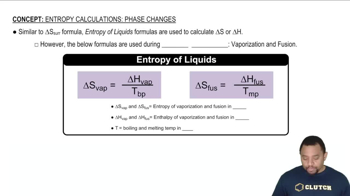
Phase changes refer to the transitions between solid, liquid, and gas states of matter. In this scenario, understanding sublimation and boiling is crucial, as CO2 sublimates at -78 °C and N2 boils at -196 °C. This means that at the temperatures in bulbs B and C, CO2 will transition from gas to solid, while N2 will transition from gas to liquid, affecting the composition of the gases in bulbs A and B.
추천 영상:
가이드 코스
01:46
Entropy in Phase Changes

Gas Laws

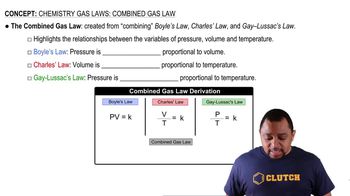
Gas laws describe the behavior of gases under various conditions of temperature and pressure. The ideal gas law (PV=nRT) is particularly relevant here, as it allows us to relate the pressure, volume, and temperature of the gases in the bulbs. When the stopcock between A and B is opened, the gases will redistribute according to these laws, leading to a new equilibrium pressure of 219 mm Hg.
추천 영상:
가이드 코스
01:43
Combined Gas Law

Equilibrium

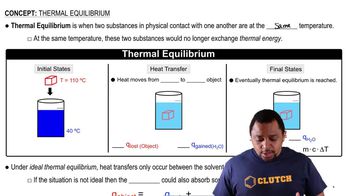
Equilibrium in a chemical system occurs when the rates of forward and reverse processes are equal, resulting in stable concentrations of reactants and products. In this case, after opening the stopcock, the gases will reach a new equilibrium state between bulbs A and B. Understanding how the gases interact and the impact of temperature on their states is essential for predicting the final contents of the bulbs.
추천 영상:
가이드 코스
02:35
Thermal Equilibrium
관련 실천
교과서 질문

The apparatus shown consists of three temperature-jacketed 1.000-L bulbs connected by stopcocks. Bulb A contains a mixture of H2O(g), CO2(g), and N2(g) at 25 °C and a total pressure of 564 mm Hg. Bulb B is empty and is held at a temperature of -70 °C. Bulb C is also empty and is held at a temperature of -190 °C. The stopcocks are closed, and the volume of the lines connecting the bulbs is zero. CO2 sublimes at -78 °C, and N2 boils at -196 °C.

(b) How many moles of H2O are in the system?

768
views
교과서 질문

Pakistan's K2 is the world's second-tallest mountain, with an altitude of 28,251 ft. Its base camp, where climbers stop to acclimate, is located about 16,400 ft above sea level. (a) Approximate atmospheric pressure P at different altitudes is given by the equation P = e-h/7000, where P is in atmospheres and h is the altitude in meters. What is the approximate atmospheric pressure in mm Hg at K2 base camp? (b) What is the atmospheric pressure in mm Hg at the summit of K2?

832
views
교과서 질문

Pakistan's K2 is the world's second-tallest mountain, with an altitude of 28,251 ft. Its base camp, where climbers stop to acclimate, is located about 16,400 ft above sea level. (c) Assuming the mole fraction of oxygen in air is 0.2095, what is the partial pressure of oxygen in mm Hg at the summit of K2?

520
views
교과서 질문
Assume that you take a flask, evacuate it to remove all the air, and find its mass to be 478.1 g. You then fill the flask with argon to a pressure of 2.15 atm and reweigh it. What would the balance read in grams if the flask has a volume of 7.35 L and the temperature is 20.0 °C?
680
views
교과서 질문
When solid mercury(I) carbonate, Hg2CO3, is added to nitric acid, HNO3, a reaction occurs to give mercury(II) nitrate, Hg1NO322, water, and two gases A and B: Hg2CO31s2 + HNO31aq2¡ Hg1NO3221aq2 + H2O1l 2 + A1g2 + B1g2 (a) When the gases are placed in a 500.0-mL bulb at 20 °C, the pressure is 258 mm Hg. How many moles of gas are present?
595
views