The matter in interstellar space consists almost entirely of hydrogen atoms at a temperature of 100 K and a density of approximately 1 atom>cm3. What is the gas pressure in millimeters of mercury?
검증된 단계별 안내
1
Identify the given values: Temperature (T) = 100 K, Density (n) = 1 atom/cm³. Note that the density needs to be converted to atoms/m³ for use in the ideal gas law.
Convert the density from atoms/cm³ to atoms/m³ by multiplying by 10^6, because 1 cm³ = 10^-6 m³.
Use the ideal gas law in the form P = nRT, where P is the pressure, n is the number density of particles, R is the gas constant, and T is the temperature. The gas constant R for this calculation should be in units that match the other given values (Joules/(mol·K)).
Calculate the number of moles per cubic meter (n) by dividing the number of atoms/m³ by Avogadro's number (approximately 6.022 x 10^23 atoms/mol).
Convert the pressure from Pascals to millimeters of mercury (mmHg) by using the conversion factor 1 atm = 760 mmHg and 1 atm = 101325 Pa.
비슷한 문제에 대한 검증된 영상 답변:
이 영상 해법은 위 문제에 도움이 된다고 튜터들이 추천한 것입니다.
영상 길이:
5m
영상 재생:
0 댓글
주요 개념
질문에 올바르게 답하기 위해 반드시 이해해야 하는 핵심 개념들은 다음과 같습니다.
Ideal Gas Law
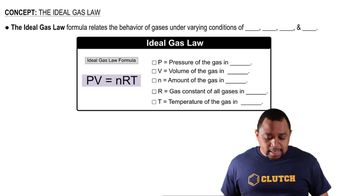
The Ideal Gas Law relates the pressure, volume, temperature, and number of moles of a gas through the equation PV = nRT. In this context, it allows us to calculate the pressure exerted by hydrogen atoms in interstellar space, given their low density and temperature.
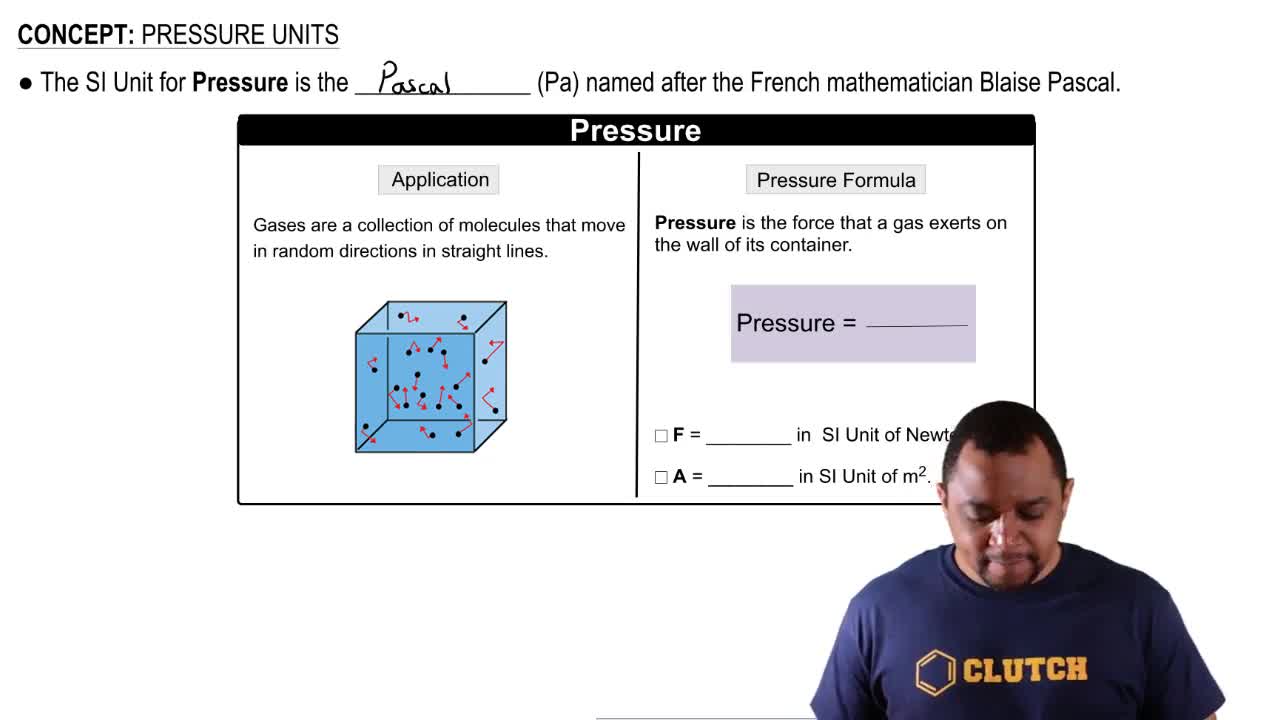
Pressure can be expressed in various units, including atmospheres (atm), pascals (Pa), and millimeters of mercury (mmHg). Understanding how to convert between these units is essential for accurately reporting the gas pressure in the context of the question.
Kinetic Molecular Theory explains the behavior of gases in terms of particle motion. It posits that gas pressure results from collisions of gas particles with the walls of a container, which is relevant for understanding how the low density and temperature of hydrogen in interstellar space affect its pressure.


 검증된 단계별 안내
 01:15
01:15