Dry ice (solid CO2) has occasionally been used as an 'explosive' in mining. A hole is drilled, dry ice and a small amount of gunpowder are placed in the hole, a fuse is added, and the hole is plugged. When lit, the exploding gunpowder rapidly vaporizes the dry ice, building up an immense pressure. Assume that 500.0 g of dry ice is placed in a cavity with a volume of 0.800 L and the ignited gunpowder heats the CO2 to 700 K. What is the final pressure inside the hole?
검증된 단계별 안내
1
Step 1: Identify the given information. The mass of dry ice (CO2) is 500.0 g, the volume of the cavity is 0.800 L, and the final temperature is 700 K.
Step 2: Convert the mass of CO2 to moles. You can do this by dividing the mass of CO2 by its molar mass. The molar mass of CO2 is approximately 44.01 g/mol.
Step 3: Use the ideal gas law equation, PV = nRT, to solve for the final pressure. In this equation, P is the pressure, V is the volume, n is the number of moles, R is the ideal gas constant, and T is the temperature. The ideal gas constant (R) can be taken as 0.0821 L·atm/(K·mol) when the volume is in liters and the temperature is in Kelvin.
Step 4: Substitute the known values into the ideal gas law equation. The number of moles (n) is the value you calculated in step 2, the volume (V) is 0.800 L, the temperature (T) is 700 K, and the ideal gas constant (R) is 0.0821 L·atm/(K·mol).
Step 5: Solve the equation for the pressure (P). This will give you the final pressure inside the hole.
비슷한 문제에 대한 검증된 영상 답변:
이 영상 해법은 위 문제에 도움이 된다고 튜터들이 추천한 것입니다.
영상 길이:
5m
영상 재생:
0 댓글
주요 개념
질문에 올바르게 답하기 위해 반드시 이해해야 하는 핵심 개념들은 다음과 같습니다.
Ideal Gas Law
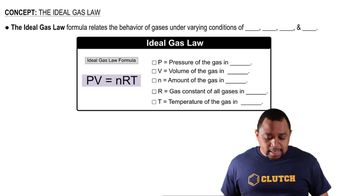
The Ideal Gas Law relates the pressure, volume, temperature, and number of moles of a gas through the equation PV = nRT. This law is essential for calculating the final pressure of gases under varying conditions, as it allows us to understand how changes in temperature and volume affect gas behavior.
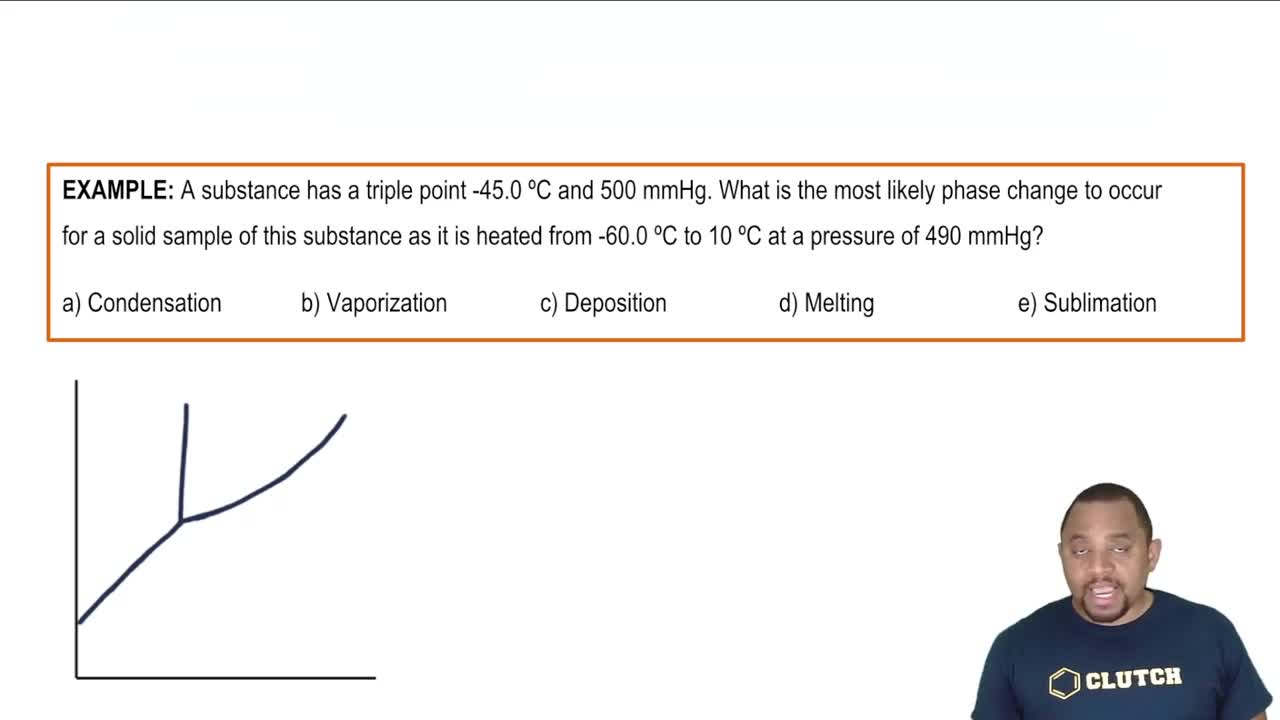
Dry ice is solid carbon dioxide that sublimates directly into gas at temperatures above -78.5 °C. Understanding sublimation is crucial in this scenario, as the rapid transition from solid to gas contributes to the pressure buildup when the dry ice is heated by the ignited gunpowder.
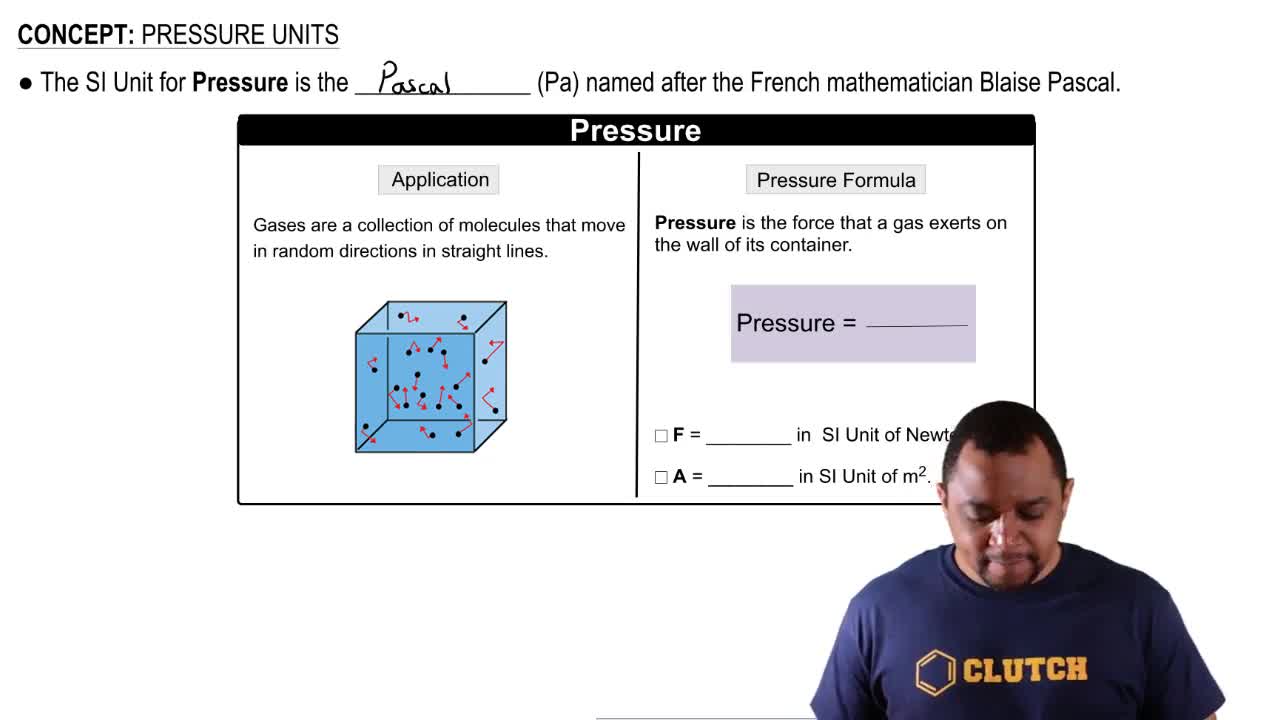
Pressure is commonly measured in units such as atmospheres (atm), pascals (Pa), or mmHg. In this problem, it is important to ensure that the final pressure is expressed in a consistent unit, which may require converting from one unit to another based on the context of the question.


 검증된 단계별 안내
 01:15
01:15