
Ch.10 - Gases: Their Properties & Behavior
McMurry - Chemistry 8th Edition
McMurry8th EditionChemistryISBN: 9781292336145당신이 사용하는 게 아니라요?교과서 변경
10장, 문제 44

What would the atmospheric pressure be in millimeters of mercury if our atmosphere were composed of pure CO2 gas?

검증된 단계별 안내
1
Step 1: Understand that atmospheric pressure is the force exerted by the weight of the atmosphere above a given point. It is commonly measured in millimeters of mercury (mmHg).
Step 2: Recognize that the current atmospheric pressure at sea level is approximately 760 mmHg, which is the pressure exerted by the Earth's atmosphere composed of a mixture of gases, primarily nitrogen and oxygen.
Step 3: Consider that if the atmosphere were composed entirely of CO2, the pressure in mmHg would depend on the density and molecular weight of CO2 compared to the current atmospheric composition.
Step 4: Use the ideal gas law, PV = nRT, to relate pressure (P), volume (V), number of moles (n), the ideal gas constant (R), and temperature (T). Assume constant temperature and volume to compare the pressures.
Step 5: Calculate the pressure exerted by pure CO2 by considering the molar mass of CO2 (44.01 g/mol) and comparing it to the average molar mass of the current atmospheric gases. This will help determine how the pressure would change if the atmosphere were composed entirely of CO2.

주요 개념

질문에 올바르게 답하기 위해 반드시 이해해야 하는 핵심 개념들은 다음과 같습니다.

Atmospheric Pressure

Atmospheric pressure is the force exerted by the weight of air above a given point, typically measured in units such as atmospheres (atm), pascals (Pa), or millimeters of mercury (mmHg). At sea level, standard atmospheric pressure is approximately 760 mmHg. Understanding how pressure is defined and measured is crucial for analyzing how different gases contribute to atmospheric conditions.
추천 영상:
가이드 코스
02:09
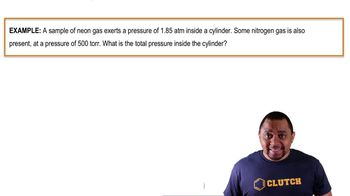
Total Pressure Example

Ideal Gas Law

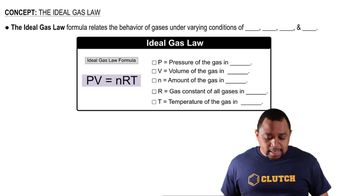
The Ideal Gas Law is a fundamental equation in chemistry that relates the pressure, volume, temperature, and number of moles of a gas. It is expressed as PV = nRT, where P is pressure, V is volume, n is the number of moles, R is the ideal gas constant, and T is temperature in Kelvin. This law helps predict how gases behave under various conditions, which is essential for calculating the pressure of a hypothetical atmosphere composed entirely of CO2.
추천 영상:
가이드 코스
01:15
Ideal Gas Law Formula

Molar Mass and Density of CO2

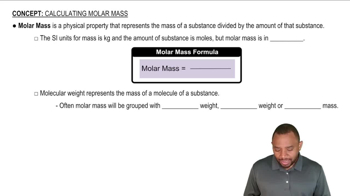
The molar mass of carbon dioxide (CO2) is approximately 44.01 g/mol, which influences its density and behavior in the atmosphere. The density of a gas affects how much of it can be present in a given volume at a specific temperature and pressure. Understanding the molar mass and density of CO2 is important for determining how it would alter atmospheric pressure compared to the current mixture of gases in Earth's atmosphere.
추천 영상:
가이드 코스
02:11
Molar Mass Concept