Ch.10 - Gases: Their Properties & Behavior
McMurry - Chemistry 8th Edition
McMurry8th EditionChemistryISBN: 9781292336145당신이 사용하는 게 아니라요?교과서 변경
10장, 문제 37

Why are gases so much more compressible than solids or liquids?

검증된 단계별 안내
1
Step 1: Understand the basic structure of matter in different states. Solids have particles that are closely packed in a fixed arrangement, liquids have particles that are close but can move past each other, and gases have particles that are far apart and move freely.
Step 2: Recognize that compressibility is the ability of a substance to decrease in volume under pressure. This is largely determined by the amount of space between particles.
Step 3: Consider the particle arrangement in gases. In gases, particles are much farther apart compared to solids and liquids, meaning there is a lot of empty space between them.
Step 4: Realize that when pressure is applied to a gas, the particles can be pushed closer together because of the large amount of empty space, making gases highly compressible.
Step 5: Compare this to solids and liquids, where particles are already close together, leaving little room for compression, thus making them much less compressible than gases.

주요 개념

질문에 올바르게 답하기 위해 반드시 이해해야 하는 핵심 개념들은 다음과 같습니다.

Molecular Structure

Gases consist of widely spaced molecules that move freely and rapidly in all directions. This large distance between molecules allows for significant space to be occupied when pressure is applied, leading to high compressibility. In contrast, solids have tightly packed molecules in a fixed arrangement, while liquids have molecules that are closer than gases but still allow some movement.
추천 영상:
가이드 코스
02:08
Molecular Formula

Intermolecular Forces

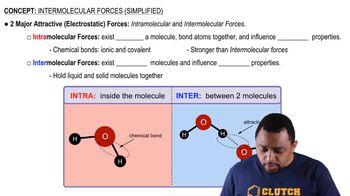
The strength of intermolecular forces plays a crucial role in the compressibility of substances. Gases experience weak intermolecular forces, allowing their molecules to be easily pushed closer together under pressure. In solids and liquids, stronger intermolecular forces resist compression, making them less compressible compared to gases.
추천 영상:
가이드 코스
01:59
Intermolecular vs Intramolecular Forces

Ideal Gas Law

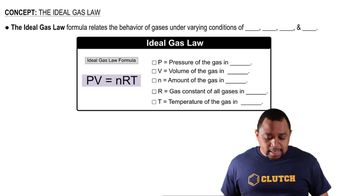
The Ideal Gas Law (PV=nRT) describes the relationship between pressure (P), volume (V), and temperature (T) of an ideal gas. It illustrates how gases can expand or compress significantly with changes in pressure and temperature, highlighting their compressibility. This law does not apply to solids and liquids in the same way, as their volume changes very little under pressure.
추천 영상:
가이드 코스
01:15
Ideal Gas Law Formula