Ch.10 - Gases: Their Properties & Behavior
McMurry - Chemistry 8th Edition
McMurry8th EditionChemistryISBN: 9781292336145당신이 사용하는 게 아니라요?교과서 변경
10장, 문제 35

If the density of water is 1.00 g/mL and the density of mercury is 13.6 g/mL, how high a column of water in meters can be supported by standard atmospheric pressure? By 1 bar?

검증된 단계별 안내
1
Identify the pressure exerted by the atmosphere. Standard atmospheric pressure is typically about 101,325 Pascals (Pa), and 1 bar is exactly 100,000 Pa.
Understand that the pressure exerted by a liquid column is given by the formula: \( P = \rho \cdot g \cdot h \), where \( P \) is the pressure, \( \rho \) is the density of the liquid, \( g \) is the acceleration due to gravity (approximately 9.81 m/s^2), and \( h \) is the height of the liquid column.
Substitute the density of water (1.00 g/mL or 1000 kg/m^3) into the formula to calculate the height of the water column for each pressure scenario. Convert the density into appropriate units if necessary.
Rearrange the formula to solve for the height of the water column, \( h \): \( h = \frac{P}{\rho \cdot g} \).
Calculate the height of the water column for both standard atmospheric pressure and 1 bar using the rearranged formula.

비슷한 문제에 대한 검증된 영상 답변:

이 영상 해법은 위 문제에 도움이 된다고 튜터들이 추천한 것입니다.
영상 길이:
5m

주요 개념

질문에 올바르게 답하기 위해 반드시 이해해야 하는 핵심 개념들은 다음과 같습니다.

Density

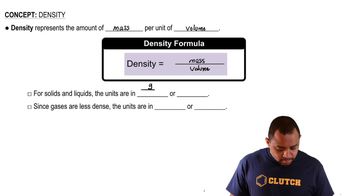
Density is defined as mass per unit volume, typically expressed in grams per milliliter (g/mL) for liquids. It is a crucial property that influences how fluids behave under pressure. In this question, the densities of water and mercury are compared to determine how high a column of water can be supported by atmospheric pressure, illustrating the relationship between density and fluid column height.
추천 영상:
가이드 코스
01:56
Density Concepts

Hydrostatic Pressure

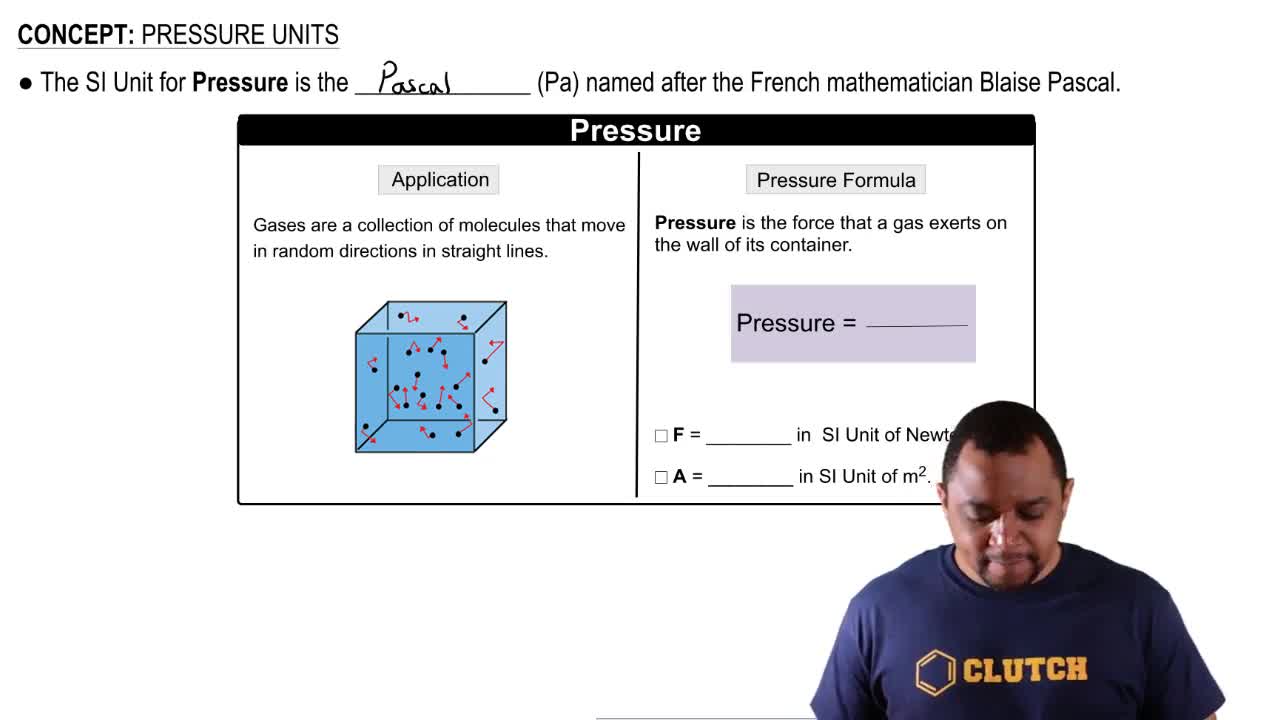
Hydrostatic pressure is the pressure exerted by a fluid at equilibrium due to the force of gravity. It is calculated using the formula P = ρgh, where P is pressure, ρ is density, g is acceleration due to gravity, and h is the height of the fluid column. This concept is essential for understanding how the height of a liquid column relates to the pressure exerted by that liquid, which is key to solving the question.
추천 영상:

Atmospheric Pressure

Atmospheric pressure is the pressure exerted by the weight of the atmosphere above a given point, typically measured at sea level as approximately 101.3 kPa (or 1 bar). This pressure can support a column of liquid, and in this question, it is used to determine how high a column of water can be supported. Understanding atmospheric pressure is vital for calculating the height of the water column in relation to the densities of the fluids involved.
추천 영상:
가이드 코스
02:09
Total Pressure Example