Ch.11 - Liquids & Phase Changes
McMurry - Chemistry 8th Edition
McMurry8th EditionChemistryISBN: 9781292336145당신이 사용하는 게 아니라요?교과서 변경
11장, 문제 70

Intermolecular forces are important in creating ordered arrangements in liquid crystals. What types of intermolecu- lar forces exist in a sample of the following compound? Chemical structure of a compound relevant to intermolecular forces in liquid crystals.

검증된 단계별 안내
1
Identify the functional groups present in the compound. In this case, the compound has a benzene ring with a methoxy group (-OCH3), an amino group (-NH2), and a carboxylic acid group (-COOH).
Determine the types of intermolecular forces each functional group can participate in. The methoxy group can engage in dipole-dipole interactions and London dispersion forces. The amino group can participate in hydrogen bonding, dipole-dipole interactions, and London dispersion forces. The carboxylic acid group can engage in hydrogen bonding, dipole-dipole interactions, and London dispersion forces.
Consider the overall structure of the molecule and how these functional groups might interact with each other and with other molecules. The benzene ring can participate in π-π interactions, which are a type of London dispersion force.
Summarize the types of intermolecular forces present in the compound. These include hydrogen bonding (from the -NH2 and -COOH groups), dipole-dipole interactions (from the -OCH3, -NH2, and -COOH groups), London dispersion forces (from the entire molecule, including the benzene ring), and π-π interactions (from the benzene ring).
Conclude that the compound exhibits a combination of hydrogen bonding, dipole-dipole interactions, London dispersion forces, and π-π interactions, which contribute to the ordered arrangements in liquid crystals.

비슷한 문제에 대한 검증된 영상 답변:

이 영상 해법은 위 문제에 도움이 된다고 튜터들이 추천한 것입니다.
영상 길이:
1m
도움이 되었나요?

주요 개념

질문에 올바르게 답하기 위해 반드시 이해해야 하는 핵심 개념들은 다음과 같습니다.

Intermolecular Forces

Intermolecular forces are the attractive forces between molecules that influence physical properties such as boiling and melting points. The main types include hydrogen bonding, dipole-dipole interactions, and London dispersion forces. Understanding these forces is crucial for analyzing the behavior of substances, particularly in states of matter like liquids and solids.
추천 영상:
가이드 코스
01:59
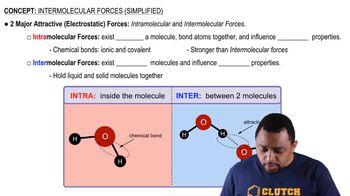
Intermolecular vs Intramolecular Forces

Hydrogen Bonding

Hydrogen bonding is a strong type of dipole-dipole interaction that occurs when hydrogen is covalently bonded to highly electronegative atoms like oxygen, nitrogen, or fluorine. In the compound shown, the presence of the -COOH (carboxylic acid) and -NH2 (amine) groups allows for significant hydrogen bonding, which contributes to the compound's solubility and structural properties in liquid crystals.
추천 영상:
가이드 코스
01:22
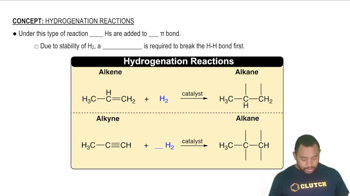
Hydrogenation Reactions

Liquid Crystals

Liquid crystals are materials that exhibit properties between those of liquids and solid crystals. They have ordered molecular arrangements that can change in response to temperature or electric fields. The intermolecular forces present in liquid crystals, such as hydrogen bonding and van der Waals forces, play a critical role in maintaining their unique phases and behaviors, making them essential in applications like displays and sensors.
추천 영상:
가이드 코스
03:04
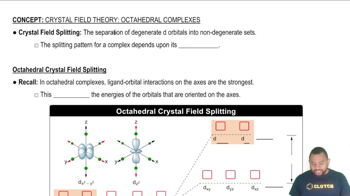
The crystal field splitting pattern for octahedral complexes has the d orbitals on or along the axes as having the higher energy.
관련 실천