Ch.11 - Liquids & Phase Changes
McMurry - Chemistry 8th Edition
McMurry8th EditionChemistryISBN: 9781292336145당신이 사용하는 게 아니라요?교과서 변경
11장, 문제 72

Two compounds (labeled I and II) have a liquid crystal state. Predict which compound has a higher temperature associ- ated with the solid to liquid crystal phase change. Explain your reasoning.
Diagram comparing two compounds in liquid crystal state for phase change analysis.

검증된 단계별 안내
1
Examine the structures of compounds I and II in the provided image.
Identify the functional groups and structural features of each compound.
Consider the molecular interactions that could affect the phase change temperature, such as hydrogen bonding, van der Waals forces, and dipole-dipole interactions.
Compare the rigidity and symmetry of the molecular structures, as these can influence the stability of the solid and liquid crystal phases.
Predict which compound has a higher temperature associated with the solid to liquid crystal phase change based on the analysis of molecular interactions and structural features.

비슷한 문제에 대한 검증된 영상 답변:

이 영상 해법은 위 문제에 도움이 된다고 튜터들이 추천한 것입니다.
영상 길이:
1m
도움이 되었나요?

주요 개념

질문에 올바르게 답하기 위해 반드시 이해해야 하는 핵심 개념들은 다음과 같습니다.

Liquid Crystal Phases

Liquid crystals are materials that exhibit properties between those of liquids and solid crystals. They can flow like a liquid but have some degree of order, particularly in their molecular arrangement. The transition between solid and liquid crystal states involves changes in temperature and can be influenced by molecular structure and interactions.
추천 영상:
가이드 코스
03:22
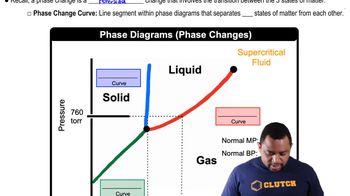
Phase Changes in Diagrams

Phase Transition Temperature

The phase transition temperature is the specific temperature at which a substance changes from one phase to another, such as from solid to liquid crystal. This temperature is influenced by intermolecular forces, molecular weight, and structural characteristics of the compounds. Higher phase transition temperatures typically indicate stronger intermolecular interactions.
추천 영상:
가이드 코스
03:22
Phase Changes in Diagrams

Intermolecular Forces

Intermolecular forces are the forces of attraction or repulsion between molecules. These forces, including hydrogen bonding, dipole-dipole interactions, and van der Waals forces, play a crucial role in determining the physical properties of substances, including their melting points and phase transition temperatures. Stronger intermolecular forces generally lead to higher phase transition temperatures.
추천 영상:
가이드 코스
01:59
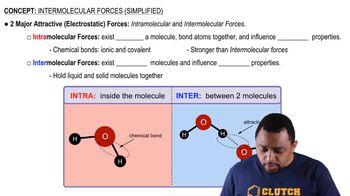
Intermolecular vs Intramolecular Forces
관련 실천
교과서 질문
The chlorofluorocarbon refrigerant trichlorofluoromethane, CCl3F, has Pvap = 100.0 mm Hg at -23 °C and ΔHvap = 24.77 kJ>mol. (b) What is ΔSvap for trichlorofluoromethane?
777
views
교과서 질문
Benzene has a melting point of 5.53 °C and a boiling point of 80.09 °C at atmospheric pressure. Its density is0.8787 g>cm3 when liquid and 0.899 g>cm3 when solid; it has Tc = 289.01 °C, Pc = 48.34 atm, Tt = 5.52 °C, and Pt = 0.0473 atm. Starting from a point at 200 K and 66.5 atm, trace the following path on a phase diagram. (1) First, increase T to 585 K while keeping P constant. (2) Next, decrease P to 38.5 atm while keeping T constant. (3) Then, decrease T to 278.66 K while keeping P constant. (4) Finally, decrease P to 0.0025 atm while keeping T constant. What is your starting phase, and what is your final phase?
2486
views
교과서 질문
Substance X has a vapor pressure of 100 mm Hg at its triple point (48 °C). When 1 mol of X is heated at 1 atm pres- sure with a constant rate of heat input, the following heating curve is obtained: (b) For each of the following, choose which phase of X (solid, liquid, or gas) fits the description. (iii) Has the greatest specific heat

511
views
교과서 질문
The compound cholesteryl benzoate is a rod-like molecule that undergoes a phase change from the solid to the liq- uid crystal phase at 145.5 °C. When cholesteryl benzoate is mixed with cholesteryl oleyl carbonate, a molecule with a curved shape, the temperature of the solid to liquid crys- tal transition changes. Predict if the transition temperature increases or decreases and explain your reasoning.
754
views
교과서 질문
Intermolecular forces are important in creating ordered arrangements in liquid crystals. What types of intermolecu- lar forces exist in a sample of the following compound?

410
views