Ch.12 - Solids and Solid-State Materials
McMurry - Chemistry 8th Edition
McMurry8th EditionChemistryISBN: 9781292336145당신이 사용하는 게 아니라요?교과서 변경
12장, 문제 137b

A cube-shaped crystal of an alkali metal, 1.62 mm on an edge, was vaporized in a 500.0 mL evacuated flask. The resulting vapor pressure was 12.5 mm Hg at 802 °C. The structure of the solid metal is known to be body-centered cubic. (b) Use the data in Figure 5.19 to identify the alkali metal.

검증된 단계별 안내
1
Calculate the volume of the cube-shaped crystal using the formula for the volume of a cube, V = s^3, where s is the length of an edge of the cube.
Determine the number of unit cells in the crystal by dividing the volume of the crystal by the volume of a single unit cell. The volume of a unit cell in a body-centered cubic structure can be calculated using the formula V_{cell} = (2r)^3, where r is the radius of an atom.
Calculate the number of atoms in the crystal. In a body-centered cubic structure, there are 2 atoms per unit cell.
Use the ideal gas law to find the number of moles of the metal vapor in the flask. The ideal gas law is PV = nRT, where P is the pressure, V is the volume, n is the number of moles, R is the gas constant, and T is the temperature in Kelvin.
Compare the calculated molar mass of the metal with the molar masses of known alkali metals to identify the metal. The molar mass can be calculated by dividing the mass of the metal by the number of moles of metal vapor.

비슷한 문제에 대한 검증된 영상 답변:

이 영상 해법은 위 문제에 도움이 된다고 튜터들이 추천한 것입니다.
영상 길이:
6m
도움이 되었나요?

주요 개념

질문에 올바르게 답하기 위해 반드시 이해해야 하는 핵심 개념들은 다음과 같습니다.

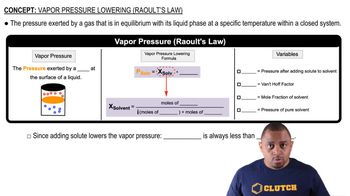
Vapor Pressure

Vapor pressure is the pressure exerted by a vapor in equilibrium with its liquid or solid phase at a given temperature. It indicates how readily a substance vaporizes; higher vapor pressures suggest a greater tendency to evaporate. In this question, the vapor pressure of the alkali metal at a specific temperature is crucial for identifying the metal based on its physical properties.
추천 영상:
가이드 코스
02:40
Raoult's Law and Vapor Pressure

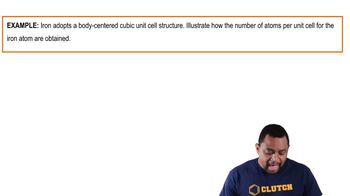
Body-Centered Cubic Structure

A body-centered cubic (BCC) structure is a type of crystal lattice where atoms are located at each corner of a cube and a single atom is positioned at the center of the cube. This arrangement affects the physical properties of the metal, including its density and atomic packing. Understanding the BCC structure helps in determining the characteristics of the alkali metal in question.
추천 영상:
가이드 코스
00:40
Body Centered Cubic Example

Alkali Metals

Alkali metals are a group of elements in Group 1 of the periodic table, characterized by their single valence electron, high reactivity, and low density. They include lithium, sodium, potassium, rubidium, cesium, and francium. Identifying the specific alkali metal involves comparing the calculated properties, such as molar mass and vapor pressure, with known values for these elements.
추천 영상:
가이드 코스
03:12
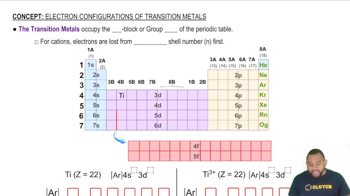
Transition Metals
관련 실천
교과서 질문
Explain why silicon carbide–reinforced alumina is stronger and tougher than pure alumina.
343
views

교과서 질문

A cube-shaped crystal of an alkali metal, 1.62 mm on an edge, was vaporized in a 500.0 mL evacuated flask. The resulting vapor pressure was 12.5 mm Hg at 802 °C. The structure of the solid metal is known to be body-centered cubic. (c) What are the densities of the solid and the vapor in g>cm3?

492
views
교과서 질문

A group 3A metal has a density of 2.70 g/cm3 and a cubic unit cell with an edge length of 404 pm. Reaction of A 1.07 cm3 chunk of the metal with an excess of hydrochloric acid gives a colorless gas that occupies 4.00 L at 23.0 °C and a pressure of 740 mm Hg. (a) Identify the metal.

356
views
교과서 질문
Europium(II) oxide is a semiconductor with a band gap of 108 kJ/mol. Below 69 K, it is also ferromagnetic, meaning all the unpaired electrons on europium are aligned in the same direction. How many f electrons are present on each europium ion in EuO? (In lanthanide ions the 4f orbitals are lower in energy than the 6s orbitals.)
556
views
교과서 질문
Assume that 1.588 g of an alkali metal undergoes complete reaction with the amount of gaseous halogen contained in a 0.500 L flask at 298 K and 755 mm Hg pressure. In the reaction, 22.83 kJ is released 1ΔH = -22.83 kJ2. The product, a binary ionic compound, crystallizes in a unit cell with anions in a face-centered cubic arrangement and with cations centered along each edge between anions. In addition, there is a cation in the center of the cube. (c) Sketch a space-filling, head-on view of the unit cell, labeling the ions. Are the anions in contact with one another?
409
views