Ch.12 - Solids and Solid-State Materials
McMurry - Chemistry 8th Edition
McMurry8th EditionChemistryISBN: 9781292336145당신이 사용하는 게 아니라요?교과서 변경
12장, 문제 136a

A group 3A metal has a density of 2.70 g/cm3 and a cubic unit cell with an edge length of 404 pm. Reaction of A 1.07 cm3 chunk of the metal with an excess of hydrochloric acid gives a colorless gas that occupies 4.00 L at 23.0 °C and a pressure of 740 mm Hg. (a) Identify the metal.

검증된 단계별 안내
1
Calculate the molar mass of the metal using the given density and unit cell edge length. First, convert the edge length from picometers to centimeters. Then, use the formula for the volume of a cube (V = edge length^3) to find the volume of the unit cell. Multiply the volume by the density to find the mass of the unit cell. Since the metal is in group 3A, assume there are four atoms per unit cell (based on its cubic structure). Divide the mass of the unit cell by four to find the mass of one atom, and then convert this mass to molar mass (g/mol).
Determine the amount of gas produced by using the ideal gas law, PV = nRT. Convert the pressure from mm Hg to atm, and use the temperature in Kelvin. Solve for n, the number of moles of gas produced.
Assume the gas produced is hydrogen gas (H2), which is typical when metals react with hydrochloric acid. The stoichiometry of the reaction between the metal and hydrochloric acid is typically M + 2HCl -> MCl2 + H2, where M represents the metal. This indicates that the moles of metal reacted will be half the moles of hydrogen gas produced.
Use the moles of metal calculated in the previous step and the molar mass from the first step to find the mass of the metal that reacted. Compare this mass to the initial mass of the metal chunk to ensure the calculation is consistent.
Identify the metal by comparing the calculated molar mass with known molar masses of group 3A metals (Aluminum, Gallium, Indium, etc.). The closest match will likely be the identity of the metal.

비슷한 문제에 대한 검증된 영상 답변:

이 영상 해법은 위 문제에 도움이 된다고 튜터들이 추천한 것입니다.
영상 길이:
8m
도움이 되었나요?

주요 개념

질문에 올바르게 답하기 위해 반드시 이해해야 하는 핵심 개념들은 다음과 같습니다.

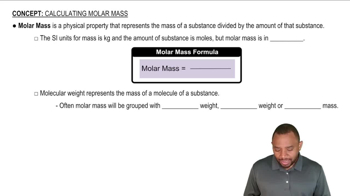
Density and Molar Mass

Density is defined as mass per unit volume and is crucial for identifying substances. In this question, the density of the metal (2.70 g/cm³) can be used to calculate its molar mass by determining the mass of the given volume of the metal. This relationship helps in identifying the metal by comparing the calculated molar mass with known values of group 3A metals.
추천 영상:
가이드 코스
02:11
Molar Mass Concept

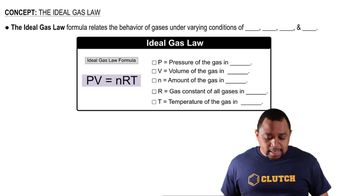
Ideal Gas Law

The Ideal Gas Law (PV = nRT) relates the pressure, volume, temperature, and number of moles of a gas. In this scenario, the gas produced from the reaction with hydrochloric acid can be analyzed using this law to find the number of moles of gas generated. This information is essential for determining the stoichiometry of the reaction and ultimately identifying the metal.
추천 영상:
가이드 코스
01:15
Ideal Gas Law Formula

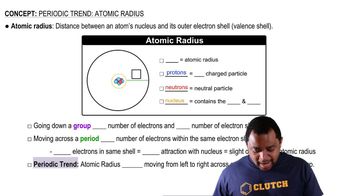
Unit Cell and Atomic Radius

The unit cell is the smallest repeating unit in a crystal lattice, and its edge length can be used to calculate the atomic radius of the metal. Given the edge length of 404 pm, one can derive the volume of the unit cell and relate it to the number of atoms per unit cell. This information, combined with the density, aids in identifying the metal by comparing its calculated atomic radius with known values.
추천 영상: