
Ch.12 - Solids and Solid-State Materials
McMurry - Chemistry 8th Edition
McMurry8th EditionChemistryISBN: 9781292336145당신이 사용하는 게 아니라요?교과서 변경
12장, 문제 9

The molecular orbital diagram of a doped semiconductor is shown below. If the semiconductor is silicon, does the diagram represent n-type or p-type doping and which of the following elements could be dopant? (LO 12.9) Molecular orbital diagram of a doped semiconductor, illustrating n-type and p-type doping options.
(a) n-type, As (b) n-type, Ga (c) p-type, As (d) p-type, Ga

검증된 단계별 안내
1
Examine the molecular orbital diagram provided. Identify the position of the Fermi level relative to the conduction and valence bands.
Determine if the Fermi level is closer to the conduction band or the valence band. If it is closer to the conduction band, it indicates n-type doping. If it is closer to the valence band, it indicates p-type doping.
For n-type doping, the dopant element should have more valence electrons than the host semiconductor (silicon, which has 4 valence electrons). For p-type doping, the dopant element should have fewer valence electrons than the host semiconductor.
Identify the elements given in the options: Arsenic (As) has 5 valence electrons, and Gallium (Ga) has 3 valence electrons.
Match the type of doping (n-type or p-type) with the appropriate dopant element based on the number of valence electrons.

비슷한 문제에 대한 검증된 영상 답변:

이 영상 해법은 위 문제에 도움이 된다고 튜터들이 추천한 것입니다.
영상 길이:
3m
도움이 되었나요?

주요 개념

질문에 올바르게 답하기 위해 반드시 이해해야 하는 핵심 개념들은 다음과 같습니다.

Doping in Semiconductors

Doping is the intentional introduction of impurities into a semiconductor to modify its electrical properties. N-type doping involves adding elements that have more valence electrons than the semiconductor, creating extra electrons. P-type doping, on the other hand, involves adding elements with fewer valence electrons, creating 'holes' or positive charge carriers. Understanding the type of doping is crucial for determining the semiconductor's conductivity and behavior.
추천 영상:
가이드 코스
03:37
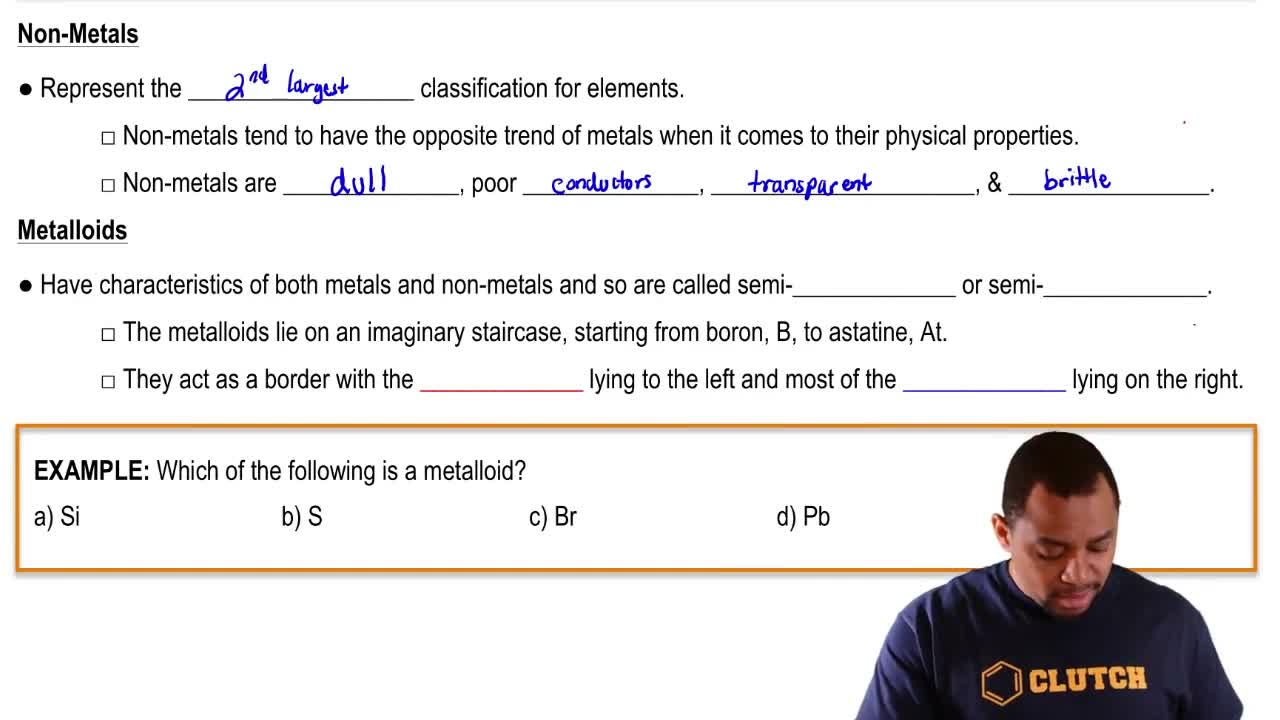
Metalloid Properties

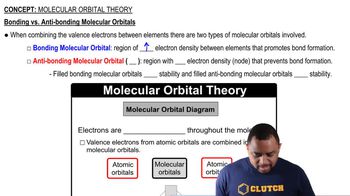
Molecular Orbital Theory

Molecular Orbital Theory explains how atomic orbitals combine to form molecular orbitals, which can be occupied by electrons. In the context of semiconductors, the energy levels of these orbitals determine the material's electrical properties. The diagram in the question likely illustrates the filling of these orbitals, indicating whether the semiconductor is n-type or p-type based on the position of the added dopant's energy levels relative to the conduction and valence bands.
추천 영상:
가이드 코스
03:06
Molecular Orbital Theory

Dopant Elements

Dopant elements are specific atoms added to a semiconductor to achieve n-type or p-type characteristics. For silicon, common n-type dopants include phosphorus and arsenic, which have five valence electrons, while p-type dopants include boron and gallium, which have three valence electrons. Identifying the correct dopant is essential for tailoring the semiconductor's properties for specific applications, such as in transistors or diodes.
추천 영상:
가이드 코스
02:35
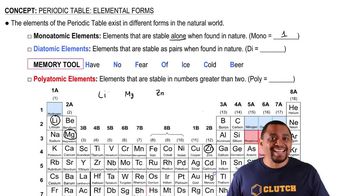
Elemental Forms of Elements
관련 실천
교과서 질문
The following diagrams represent the electron population of the composite s–d band for three metals—Ag, Mo, and Y:

Which diagram corresponds to which metal? (LO 12.7) (a) Ag = 3, Mo = 1, Y = 2 (b) Ag = 2, Mo = 1, Y = 3 (c) Ag = 2, Mo = 3, Y = 1 (d) Ag = 1, Mo = 2, Y = 3
344
views
교과서 질문

Identify each of the following kinds of packing: (b)

304
views
교과서 질문
A superconductor is a material that loses all electrical resistance below a characteristic temperature called the superconducting transition temperature. Which graph represents the behavior of a superconductor? (LO 12.13) (a)

(b)

(c)

(d)

279
views
교과서 질문
If the band-gap energy of a gallium phosphide (GaP) semiconductor is 222 kJ/mol, calculate the wavelength of light emitted in a GaP light-emitting diode (LED). (LO 12.11) (a) 186 nm (b) 245 nm (c) 539 nm (d) 854 nm
325
views
교과서 질문
Examine diagrams for the electron population of the composite s–d band for three metals in question 6. Which metal has the highest melting point? (LO 12.7) (a) Metal 1 (b) Metal 2 (c) Metal 3

361
views
교과서 질문
The following diagrams represent the electron population of molecular orbitals for different substances. What diagram corresponds to magnesium oxide, germanium, and tin? (LO 12.8)

(a) Diagram 1 = tin, diagram 2 = magnesium oxide, diagram 3 = germanium (b) Diagram 1 = germanium, diagram 2 = magnesium oxide, diagram 3 = tin (c) Diagram 1 = germanium, diagram 2 = tin, diagram 3 = magnesium oxide (d) Diagram 1 = magnesium oxide, diagram 2 = tin, diagram 3 = germanium
265
views