Identify each of the following kinds of packing: (b)
검증된 단계별 안내
1
Observe the arrangement of the spheres in the image. Notice that the spheres are arranged in a cubic pattern.
Identify the type of unit cell. In this case, the spheres are positioned at the corners of a cube.
Recall the types of cubic unit cells: simple cubic, body-centered cubic (BCC), and face-centered cubic (FCC).
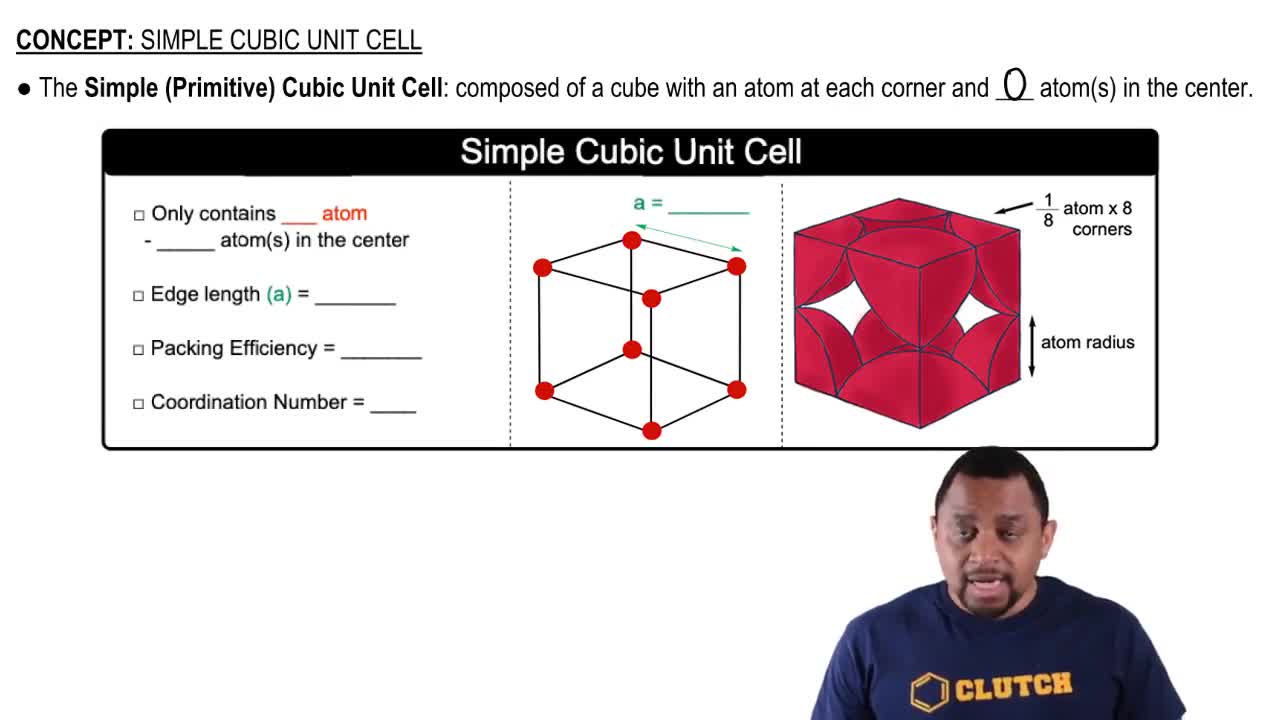
Determine that in a simple cubic unit cell, atoms are only at the corners of the cube.
Conclude that the given image represents a simple cubic unit cell packing.
비슷한 문제에 대한 검증된 영상 답변:
이 영상 해법은 위 문제에 도움이 된다고 튜터들이 추천한 것입니다.
영상 길이:
55s
영상 재생:
0 댓글
주요 개념
질문에 올바르게 답하기 위해 반드시 이해해야 하는 핵심 개념들은 다음과 같습니다.
Unit Cell
A unit cell is the smallest repeating unit in a crystal lattice that reflects the symmetry and structure of the entire crystal. It defines the arrangement of atoms, ions, or molecules in a solid and is characterized by its dimensions and angles. Understanding unit cells is crucial for analyzing the packing of atoms in solids, as they determine the overall properties of the material.
Cubic packing refers to a specific arrangement of atoms in a three-dimensional space where the atoms are positioned at the corners and sometimes the center of a cube. The most common types of cubic packing are simple cubic, body-centered cubic (BCC), and face-centered cubic (FCC). Each type has distinct coordination numbers and packing efficiencies, influencing the material's density and stability.
The coordination number is the number of nearest neighboring atoms surrounding a central atom in a crystal structure. It is a key factor in determining the stability and properties of the crystal. For example, in a simple cubic structure, the coordination number is 6, meaning each atom is in contact with six others, which affects how tightly the atoms are packed and the overall density of the material.



 검증된 단계별 안내
 01:27
01:27