Which of the substances Na3PO4, CBr4, rubber, Au, and
quartz best fits each of the following descriptions?
(a) Amorphous solid
(b) Ionic solid
(c) Molecular solid
(d) Covalent network solid
(e) Metallic solid
검증된 단계별 안내
1
(a) Amorphous solid: Amorphous solids do not have a regular arrangement of particles. They are often formed when a liquid cools rapidly and particles do not get enough time to form a regular pattern. An example of an amorphous solid in the given list is rubber.
(b) Ionic solid: Ionic solids are composed of positive and negative ions held together by electrostatic forces. They have high melting points and are hard and brittle. An example of an ionic solid in the given list is Na3PO4.
(c) Molecular solid: Molecular solids are composed of molecules held together by intermolecular forces. They have relatively low melting points and are often soft. An example of a molecular solid in the given list is CBr4.
(d) Covalent network solid: Covalent network solids are composed of atoms held together by covalent bonds in a giant 3D network. They have very high melting points and are very hard. An example of a covalent network solid in the given list is quartz.
(e) Metallic solid: Metallic solids are composed of metal atoms held together by a 'sea' of collectively shared electrons. They are good conductors of heat and electricity and are malleable and ductile. An example of a metallic solid in the given list is Au.
비슷한 문제에 대한 검증된 영상 답변:
이 영상 해법은 위 문제에 도움이 된다고 튜터들이 추천한 것입니다.
영상 길이:
2m
영상 재생:
0 댓글
주요 개념
질문에 올바르게 답하기 위해 반드시 이해해야 하는 핵심 개념들은 다음과 같습니다.
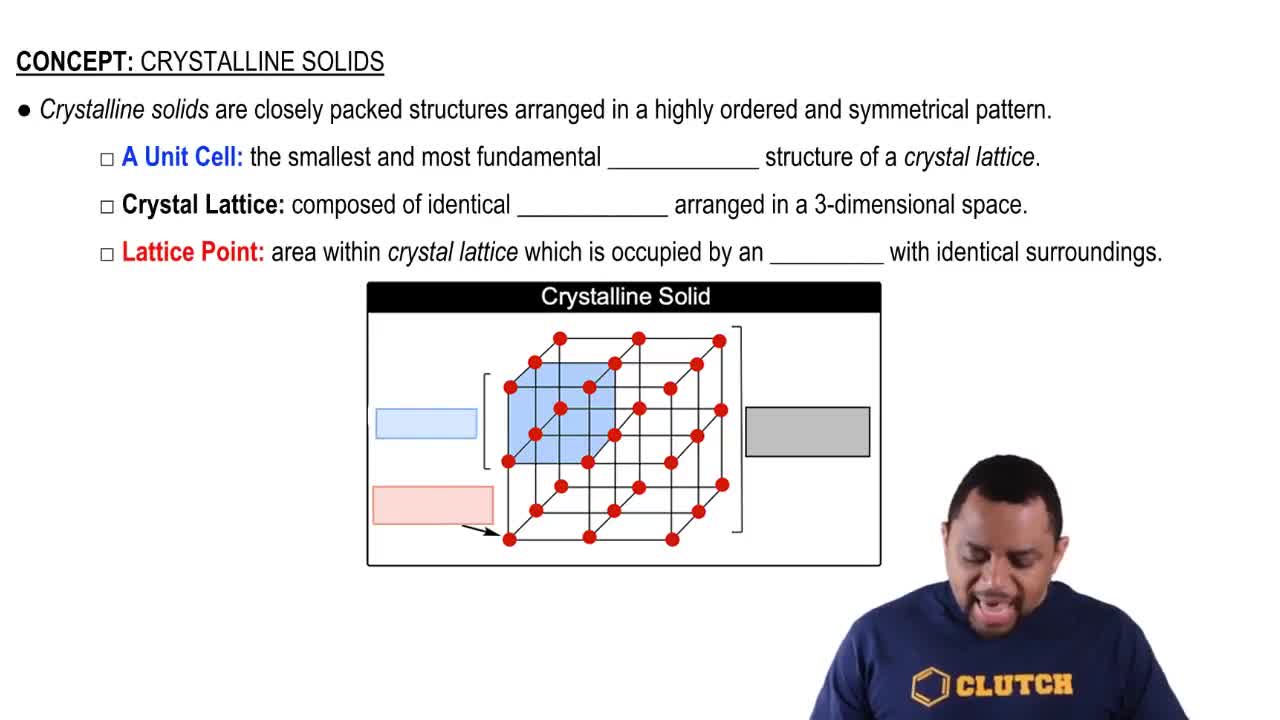
Amorphous vs. Crystalline Solids
Amorphous solids lack a long-range ordered structure, resulting in a non-uniform arrangement of particles. In contrast, crystalline solids have a well-defined geometric arrangement, leading to distinct melting points and physical properties. Understanding this distinction is crucial for identifying substances like rubber, which is amorphous, versus crystalline materials.
Solids can be categorized into different types based on their bonding and structure: ionic solids (like Na3PO4) consist of ions held together by electrostatic forces; molecular solids (like CBr4) are formed by molecules held together by van der Waals forces; covalent network solids (like quartz) feature a continuous network of covalent bonds; and metallic solids (like Au) consist of metal atoms sharing a 'sea' of electrons. Recognizing these categories is essential for classifying the given substances.
Metals, such as gold (Au), are characterized by their ability to conduct electricity and heat, malleability, and ductility due to the delocalized electrons in their structure. Nonmetals, including substances like quartz and rubber, exhibit different properties, such as brittleness and poor conductivity. Understanding these properties helps in identifying which substances fit the descriptions provided in the question.


 검증된 단계별 안내
 04:13
04:13