Ch.12 - Solids and Solid-State Materials
McMurry - Chemistry 8th Edition
McMurry8th EditionChemistryISBN: 9781292336145당신이 사용하는 게 아니라요?교과서 변경
12장, 문제 26

List the four main classes of crystalline solids, and give a specific example of each.

검증된 단계별 안내
1
1. The four main classes of crystalline solids are: Ionic Solids, Covalent Network Solids, Metallic Solids, and Molecular Solids.
2. Ionic Solids: These are solids that are composed of ions. They have high melting and boiling points due to the strong electrostatic forces between the positive and negative ions. An example of an ionic solid is Sodium Chloride (NaCl).
3. Covalent Network Solids: These are solids that are composed of atoms connected by covalent bonds. They also have high melting and boiling points due to the strong covalent bonds between the atoms. An example of a covalent network solid is Diamond (C).
4. Metallic Solids: These are solids that are composed of metal atoms. They have variable melting and boiling points and are generally malleable and ductile. An example of a metallic solid is Iron (Fe).
5. Molecular Solids: These are solids that are composed of molecules or atoms. They have low melting and boiling points due to the weak intermolecular forces between the molecules or atoms. An example of a molecular solid is Ice (H2O).

비슷한 문제에 대한 검증된 영상 답변:

이 영상 해법은 위 문제에 도움이 된다고 튜터들이 추천한 것입니다.
영상 길이:
2m
도움이 되었나요?

주요 개념

질문에 올바르게 답하기 위해 반드시 이해해야 하는 핵심 개념들은 다음과 같습니다.

Crystalline Solids

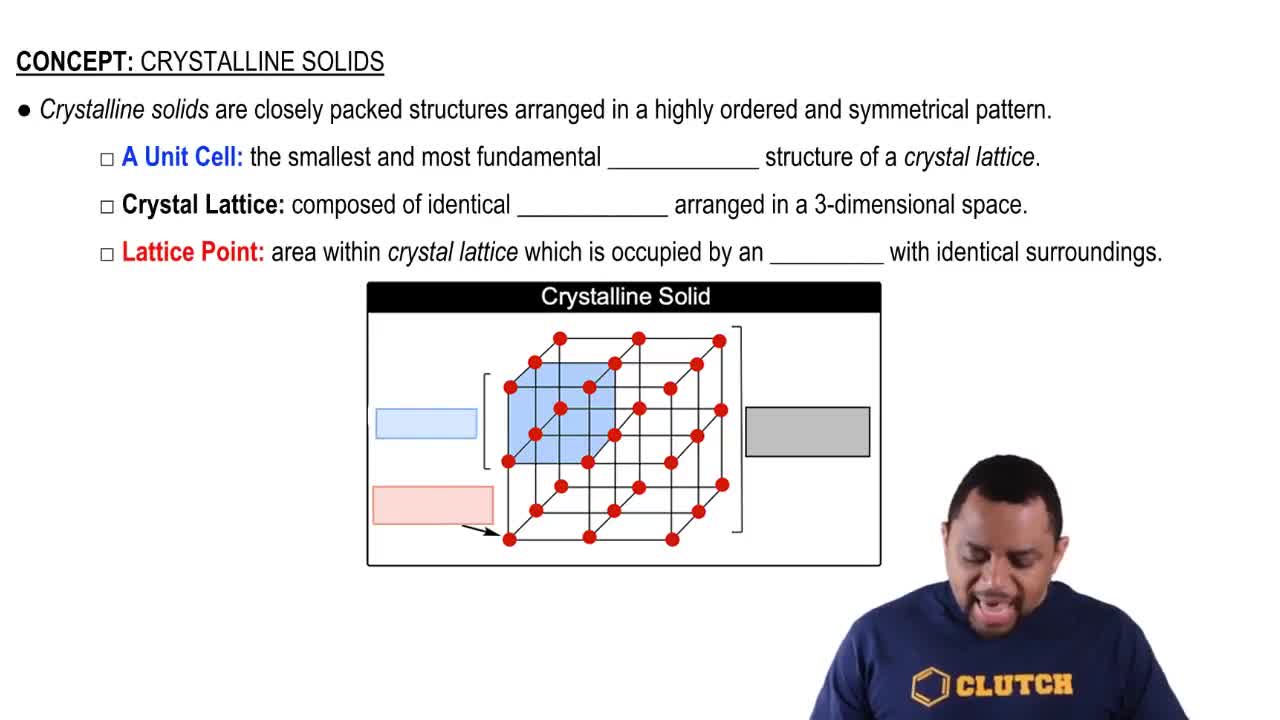
Crystalline solids are materials whose constituents, such as atoms, ions, or molecules, are arranged in a highly ordered microscopic structure, forming a crystal lattice that extends in all directions. This regular arrangement leads to distinct geometric shapes and specific physical properties, such as melting points and solubility. Understanding the nature of crystalline solids is essential for classifying them into different types based on their bonding and structure.
추천 영상:
가이드 코스
01:31
Crystalline Solids Structure

Types of Crystalline Solids

Crystalline solids can be classified into four main types: ionic, covalent (or network), metallic, and molecular solids. Each type is characterized by the nature of the bonding between its particles. For example, ionic solids consist of ions held together by electrostatic forces, while metallic solids feature a 'sea of electrons' that allows for conductivity and malleability. Recognizing these categories helps in understanding their properties and behaviors.
추천 영상:
가이드 코스
01:31
Crystalline Solids Structure

Examples of Crystalline Solids

Providing specific examples of each class of crystalline solids aids in illustrating their unique characteristics. For instance, sodium chloride (table salt) is an ionic solid, diamond represents a covalent solid, copper is a metallic solid, and ice is a molecular solid. These examples highlight the diversity in structure and properties among different types of crystalline solids, reinforcing the classification system.
추천 영상:
가이드 코스
00:34
Crystalline Solids Example