
Ch.13 - Solutions & Their Properties
McMurry - Chemistry 8th Edition
McMurry8th EditionChemistryISBN: 9781292336145당신이 사용하는 게 아니라요?교과서 변경
13장, 문제 150a

A compound that contains only C and H was burned in excess O2 to give CO2 and H2O. When 0.270 g of the com- pound was burned, the amount of CO2 formed reacted completely with 20.0 mL of 2.00 M NaOH solution according to the equation 2 OH-1aq2 + CO21g2 S CO 2- 1aq2 + H2O1l2 When 0.270 g of the compound was dissolved in 50.0 g of camphor, the resulting solution had a freezing point of 177.9 °C. [#Pure camphor freezes at 179.8 °C and has Kf = 37.7 1°C kg2>mol.] (a) What is the empirical formula of the compound?

검증된 단계별 안내
1
Determine the moles of CO2 produced by using the volume and molarity of NaOH. Since the reaction between CO2 and NaOH is a 1:2 ratio, calculate the moles of CO2 based on the stoichiometry of the reaction.
Convert the moles of CO2 to grams using the molar mass of CO2. This gives the mass of carbon in the original compound.
Calculate the mass of hydrogen in the original compound by subtracting the mass of carbon from the total mass of the compound.
Determine the moles of carbon and hydrogen in the compound using their respective molar masses.
Find the simplest whole number ratio of moles of carbon to moles of hydrogen to determine the empirical formula of the compound.

비슷한 문제에 대한 검증된 영상 답변:

이 영상 해법은 위 문제에 도움이 된다고 튜터들이 추천한 것입니다.
영상 길이:
7m
도움이 되었나요?

주요 개념

질문에 올바르게 답하기 위해 반드시 이해해야 하는 핵심 개념들은 다음과 같습니다.

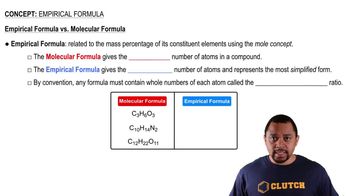
Empirical Formula

The empirical formula of a compound represents the simplest whole-number ratio of the elements present in that compound. It is determined by analyzing the composition of the compound, often through combustion analysis, which provides the amounts of carbon and hydrogen produced. This ratio is crucial for understanding the basic structure of the compound and is foundational in stoichiometry.
추천 영상:
가이드 코스
02:26
Empirical vs Molecular Formula

Combustion Analysis

Combustion analysis is a technique used to determine the elemental composition of organic compounds. In this process, the compound is burned in excess oxygen, producing carbon dioxide and water. The amounts of these products are measured, allowing for the calculation of the moles of carbon and hydrogen in the original compound, which is essential for deriving the empirical formula.
추천 영상:
가이드 코스
01:29
Combustion of Non-Hydrocarbons

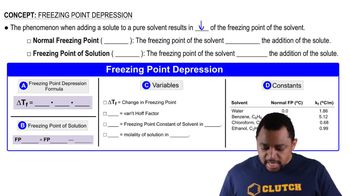
Freezing Point Depression

Freezing point depression is a colligative property that describes the lowering of the freezing point of a solvent when a solute is dissolved in it. The extent of this depression depends on the number of solute particles in the solution and is quantified using the formula ΔTf = Kf * m, where Kf is the freezing point depression constant and m is the molality of the solution. This concept is important for determining the molar mass of the compound, which aids in finding its empirical formula.
추천 영상:
가이드 코스
01:59
Freezing Point Depression
관련 실천
교과서 질문

Treatment of 1.385 g of an unknown metal M with an excess of aqueous HCl evolved a gas that was found to have a volume of 382.6 mL at 20.0 °C and 755 mm Hg pressure. Heating the reaction mixture to evaporate the water and remaining HCl then gave a white crystalline compound, MClx. After dis- solving the compound in 25.0 g of water, the melting point of the resulting solution was - 3.53 °C. (f) What is the identity of the metal M?

411
views
교과서 질문

Treatment of 1.385 g of an unknown metal M with an excess of aqueous HCl evolved a gas that was found to have a volume of 382.6 mL at 20.0 °C and 755 mm Hg pressure. Heating the reaction mixture to evaporate the water and remaining HCl then gave a white crystalline compound, MClx. After dis- solving the compound in 25.0 g of water, the melting point of the resulting solution was - 3.53 °C. (c) What is the molality of particles (ions) in the solution of MClx?

329
views
교과서 질문
A solution prepared by dissolving 100.0 g of a mixture of sugar 1C12H22O112 and table salt (NaCl) in 500.0 g of water has a freezing point of - 2.25 °C. What is the mass of each individual solute? Assume that NaCl is completely dissociated.
975
views
교과서 질문

Treatment of 1.385 g of an unknown metal M with an excess of aqueous HCl evolved a gas that was found to have a volume of 382.6 mL at 20.0 °C and 755 mm Hg pressure. Heating the reaction mixture to evaporate the water and remaining HCl then gave a white crystalline compound, MClx. After dis- solving the compound in 25.0 g of water, the melting point of the resulting solution was - 3.53 °C. (e) What are the formula and molecular weight of MClx?

292
views