
Ch.13 - Solutions & Their Properties
McMurry - Chemistry 8th Edition
McMurry8th EditionChemistryISBN: 9781292336145당신이 사용하는 게 아니라요?교과서 변경
13장, 문제 154

A solution prepared by dissolving 100.0 g of a mixture of sugar 1C12H22O112 and table salt (NaCl) in 500.0 g of water has a freezing point of - 2.25 °C. What is the mass of each individual solute? Assume that NaCl is completely dissociated.

검증된 단계별 안내
1
Step 1: First, we need to understand the concept of freezing point depression. The freezing point of a solution is lower than that of the pure solvent, and this decrease in freezing point is directly proportional to the molality of the solution. The equation for this is ΔTf = Kf * m * i, where ΔTf is the freezing point depression, Kf is the cryoscopic constant of the solvent (for water, it's 1.86 °C/m), m is the molality of the solution, and i is the van't Hoff factor (the number of particles the solute splits into in solution). For sugar, i = 1 (since it doesn't dissociate), and for NaCl, i = 2 (since it dissociates into two ions).
Step 2: We know the total freezing point depression is -2.25 °C (the negative sign indicates a decrease in freezing point). We can set up two equations to represent the contributions of sugar and NaCl to the total freezing point depression: ΔTf,sugar = Kf * m_sugar and ΔTf,NaCl = Kf * m_NaCl * 2. Adding these two equations together gives us the total freezing point depression: ΔTf,total = ΔTf,sugar + ΔTf,NaCl = -2.25 °C.
Step 3: We also know that molality (m) is defined as the number of moles of solute per kilogram of solvent. We can express m_sugar as (mass_sugar / molar mass_sugar) / mass_solvent and m_NaCl as (mass_NaCl / molar mass_NaCl) / mass_solvent. Substituting these expressions into the equations from Step 2 gives us two equations with two unknowns (mass_sugar and mass_NaCl).
Step 4: We can solve these two equations simultaneously to find the values of mass_sugar and mass_NaCl. This can be done using various methods such as substitution, elimination, or using a system of equations solver.
Step 5: Once we have the values of mass_sugar and mass_NaCl, we can check our answers by making sure that they add up to the total mass of the solute (100.0 g), and that substituting them back into the equations from Step 2 gives us the correct total freezing point depression (-2.25 °C).

비슷한 문제에 대한 검증된 영상 답변:

이 영상 해법은 위 문제에 도움이 된다고 튜터들이 추천한 것입니다.
영상 길이:
16m
도움이 되었나요?

주요 개념

질문에 올바르게 답하기 위해 반드시 이해해야 하는 핵심 개념들은 다음과 같습니다.

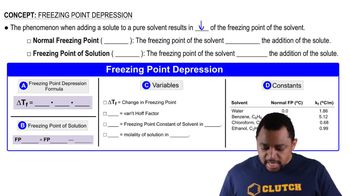
Freezing Point Depression

Freezing point depression is a colligative property that describes how the freezing point of a solvent decreases when a solute is added. The extent of this depression depends on the number of solute particles in the solution rather than their identity. The formula used to calculate the change in freezing point is ΔTf = i * Kf * m, where 'i' is the van 't Hoff factor, 'Kf' is the freezing point depression constant of the solvent, and 'm' is the molality of the solution.
추천 영상:
가이드 코스
01:59
Freezing Point Depression

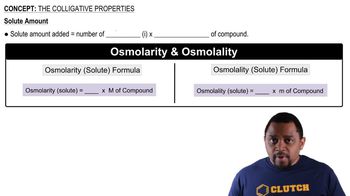
Colligative Properties

Colligative properties are properties of solutions that depend on the number of solute particles in a given amount of solvent, not on the type of solute. These properties include boiling point elevation, freezing point depression, vapor pressure lowering, and osmotic pressure. Understanding these properties is essential for calculating how solutes affect the physical properties of solvents, which is crucial in this question.
추천 영상:
가이드 코스
01:26
Colligative Properties

Dissociation of Ionic Compounds

Dissociation refers to the process by which an ionic compound separates into its constituent ions when dissolved in a solvent. For example, sodium chloride (NaCl) dissociates into Na+ and Cl- ions in solution. This dissociation increases the number of solute particles, which is important for calculating colligative properties like freezing point depression, as seen in the context of this question.
추천 영상:
가이드 코스
02:11
Ionic Compounds Naming