

Ch.13 - Solutions & Their Properties
McMurry - Chemistry 8th Edition
McMurry8th EditionChemistryISBN: 9781292336145당신이 사용하는 게 아니라요?교과서 변경
13장, 문제 85

At an altitude of 10,000 ft, the partial pressure of oxygen in the lungs is about 68 mm Hg. What is the concentration in mg/L of dissolved O2 in blood (or water) at this partial pres- sure and a normal body temperature of 37 °C? The solubil- ity of O2 in water at 37 °C and 1 atm partial pressure is 1.93 * 10-3 mol>L.

검증된 단계별 안내
1
Convert the partial pressure of oxygen from mm Hg to atmospheres (atm) since the solubility given is in terms of atm. Use the conversion factor: 1 atm = 760 mm Hg.
Calculate the partial pressure of oxygen at 10,000 ft in atm by dividing the given pressure in mm Hg by 760 mm Hg/atm.
Use Henry's Law to find the concentration of O2 in mol/L at the calculated partial pressure. Henry's Law states that the concentration of a gas in a liquid is directly proportional to the partial pressure of the gas above the liquid. Use the formula: Concentration at new pressure = (Concentration at 1 atm) * (Partial pressure in atm / 1 atm).
Convert the concentration from mol/L to mg/L. To do this, multiply the concentration in mol/L by the molar mass of O2, which is approximately 32 g/mol (or 32000 mg/mol).
The result from the previous step gives the concentration of O2 in mg/L at the altitude of 10,000 ft and a temperature of 37 °C.

비슷한 문제에 대한 검증된 영상 답변:

이 영상 해법은 위 문제에 도움이 된다고 튜터들이 추천한 것입니다.
영상 길이:
1m

주요 개념

질문에 올바르게 답하기 위해 반드시 이해해야 하는 핵심 개념들은 다음과 같습니다.

Partial Pressure

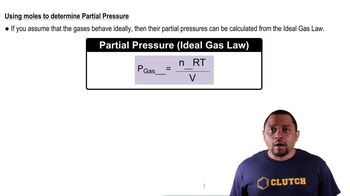
Partial pressure refers to the pressure exerted by a single component of a gas mixture. In this context, it is the pressure of oxygen in the lungs at a specific altitude, which affects how much oxygen can dissolve in blood or water. Understanding partial pressure is crucial for calculating the concentration of dissolved gases, as it directly influences solubility according to Henry's Law.
추천 영상:
가이드 코스
00:48
Partial Pressure Calculation

Henry's Law

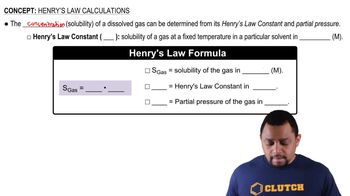
Henry's Law states that the amount of gas that dissolves in a liquid at a given temperature is directly proportional to the partial pressure of that gas above the liquid. This principle is essential for determining the concentration of dissolved oxygen in blood at different altitudes and pressures. The law can be expressed mathematically as C = kH * P, where C is the concentration, kH is the Henry's Law constant, and P is the partial pressure.
추천 영상:
가이드 코스
01:40
Henry's Law Calculations

Solubility of Gases

The solubility of gases in liquids varies with temperature and pressure. At 37 °C and 1 atm, the solubility of oxygen is given as 1.93 * 10^-3 mol/L. This value indicates how much oxygen can dissolve in water under standard conditions, and it is essential for calculating the concentration of dissolved oxygen at different partial pressures, such as the one at 10,000 ft.
추천 영상:
가이드 코스
00:28
Solubility Rules