Ch.13 - Solutions & Their Properties
McMurry - Chemistry 8th Edition
McMurry8th EditionChemistryISBN: 9781292336145당신이 사용하는 게 아니라요?교과서 변경
13장, 문제 124

Cellobiose is a sugar obtained by degradation of cellulose. If 200.0 mL of an aqueous solution containing 1.500 g of cellobiose at 25.0 °C gives rise to an osmotic pressure of 407.2 mm Hg, what is the molecular weight of cellobiose?

검증된 단계별 안내
1
Step 1: Convert the osmotic pressure from mm Hg to atm using the conversion factor 1 atm = 760 mm Hg.
Step 2: Use the formula for osmotic pressure \( \Pi = iMRT \), where \( \Pi \) is the osmotic pressure in atm, \( i \) is the van't Hoff factor (assumed to be 1 for non-electrolytes), \( M \) is the molarity, \( R \) is the ideal gas constant (0.0821 L·atm/mol·K), and \( T \) is the temperature in Kelvin.
Step 3: Convert the temperature from Celsius to Kelvin by adding 273.15 to the Celsius temperature.
Step 4: Rearrange the osmotic pressure formula to solve for molarity \( M \): \( M = \frac{\Pi}{iRT} \).
Step 5: Calculate the number of moles of cellobiose using the molarity and the volume of the solution in liters, then use the mass of cellobiose to find the molecular weight by dividing the mass by the number of moles.

주요 개념

질문에 올바르게 답하기 위해 반드시 이해해야 하는 핵심 개념들은 다음과 같습니다.

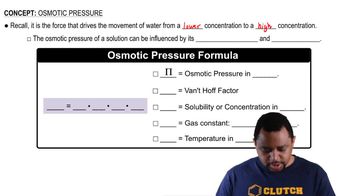
Osmotic Pressure

Osmotic pressure is the pressure required to prevent the flow of solvent into a solution through a semipermeable membrane. It is directly proportional to the concentration of solute particles in the solution, as described by the formula π = iCRT, where π is osmotic pressure, i is the van 't Hoff factor, C is the molar concentration, R is the ideal gas constant, and T is the temperature in Kelvin.
추천 영상:
가이드 코스
01:13
Osmotic Pressure Formula

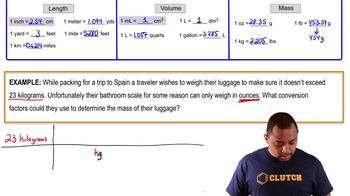
Molecular Weight

Molecular weight, or molar mass, is the mass of one mole of a substance, typically expressed in grams per mole (g/mol). It can be calculated by dividing the mass of the substance by the number of moles present. In the context of osmotic pressure, knowing the molecular weight allows for the determination of the number of moles of solute in a given mass, which is essential for calculating concentration.
추천 영상:
가이드 코스
03:45
Weight Conversion Example

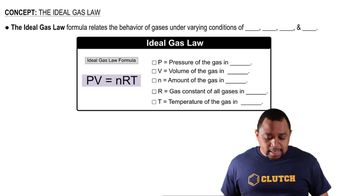
Ideal Gas Law

The Ideal Gas Law relates the pressure, volume, temperature, and number of moles of a gas through the equation PV = nRT. While it primarily applies to gases, it can be adapted for solutions in terms of osmotic pressure. Understanding this law helps in manipulating the variables to find unknowns, such as the molecular weight of solutes in solution when osmotic pressure is known.
추천 영상:
가이드 코스
01:15
Ideal Gas Law Formula