
Ch.13 - Solutions & Their Properties
McMurry - Chemistry 8th Edition
McMurry8th EditionChemistryISBN: 9781292336145당신이 사용하는 게 아니라요?교과서 변경
13장, 문제 142

Desert countries like Saudi Arabia have built reverse osmo-sis plants to produce freshwater from seawater. Assume that seawater has the composition 0.470 M NaCl and 0.068 M MgCl2 and that both compounds are completely dissociated. (b) If the reverse osmosis equipment can exert a maximum pressure of 100.0 atm at 25.0 °C, what is the maximum volume of freshwater that can be obtained from 1.00 L of seawater?

검증된 단계별 안내
1
Calculate the total molarity of ions in the seawater. Since NaCl dissociates into Na+ and Cl-, and MgCl2 dissociates into Mg2+ and 2 Cl-, add the contributions from each salt. For NaCl: 0.470 M contributes 0.470 M Na+ and 0.470 M Cl-. For MgCl2: 0.068 M contributes 0.068 M Mg2+ and 0.136 M Cl-. Sum these to find the total molarity of ions.
Use the van't Hoff factor (i) to determine the effective concentration of particles in solution. For NaCl, i = 2 (Na+ and Cl-), and for MgCl2, i = 3 (Mg2+ and 2 Cl-). Calculate the effective concentration by multiplying the molarity of each salt by its respective van't Hoff factor and then summing these values.
Apply the formula for osmotic pressure: \( \Pi = iCRT \), where \( \Pi \) is the osmotic pressure, i is the van't Hoff factor, C is the molarity of the solution, R is the ideal gas constant (0.0821 L atm/mol K), and T is the temperature in Kelvin (298 K for 25.0 °C).
Compare the osmotic pressure calculated to the maximum pressure the reverse osmosis equipment can exert (100.0 atm). If the osmotic pressure is less than or equal to the equipment's pressure, reverse osmosis can occur, allowing freshwater to be obtained.
Assuming the osmotic pressure is within the operable range, calculate the volume of freshwater that can be obtained. If the osmotic pressure equals the applied pressure, theoretically, all the seawater can be converted to freshwater. However, efficiency and system constraints typically reduce the actual volume obtainable.

비슷한 문제에 대한 검증된 영상 답변:

이 영상 해법은 위 문제에 도움이 된다고 튜터들이 추천한 것입니다.
영상 길이:
8m
도움이 되었나요?

주요 개념

질문에 올바르게 답하기 위해 반드시 이해해야 하는 핵심 개념들은 다음과 같습니다.

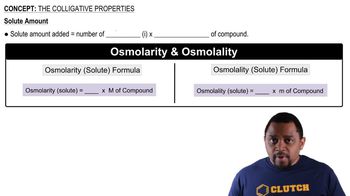
Colligative Properties

Colligative properties depend on the number of solute particles in a solution rather than their identity. In the context of seawater, the presence of NaCl and MgCl2 contributes to the total solute concentration, affecting properties like vapor pressure, boiling point, and osmotic pressure. Understanding these properties is essential for calculating the osmotic pressure exerted by the seawater, which influences the efficiency of reverse osmosis.
추천 영상:
가이드 코스
01:26
Colligative Properties

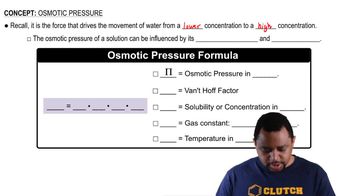
Osmotic Pressure

Osmotic pressure is the pressure required to stop the flow of solvent into a solution through a semipermeable membrane. It can be calculated using the formula π = iCRT, where π is the osmotic pressure, i is the van 't Hoff factor (number of particles the solute dissociates into), C is the molarity of the solution, R is the ideal gas constant, and T is the temperature in Kelvin. This concept is crucial for determining the maximum pressure needed to reverse the natural osmotic flow of water from seawater to freshwater.
추천 영상:
가이드 코스
01:13
Osmotic Pressure Formula

Reverse Osmosis

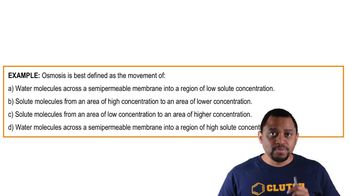
Reverse osmosis is a water purification process that uses a semipermeable membrane to remove ions, molecules, and larger particles from drinking water. By applying pressure greater than the osmotic pressure of the solution, water is forced through the membrane, leaving contaminants behind. Understanding the principles of reverse osmosis is vital for calculating how much freshwater can be produced from seawater under specific pressure conditions.
추천 영상:
가이드 코스
00:38
Osmosis Example