
Ch.13 - Solutions & Their Properties
McMurry - Chemistry 8th Edition
McMurry8th EditionChemistryISBN: 9781292336145당신이 사용하는 게 아니라요?교과서 변경
13장, 문제 144

Elemental analysis of b@carotene, a dietary source of vitamin A, shows that it contains 10.51% H and 89.49% C. Dissolving 0.0250 g of b@carotene in 1.50 g of camphor gives a freezing- point depression of 1.17 °C. What are the molecular weight and formula of b@carotene? [Kf for camphor is 37.7 1°C kg2>mol.]

검증된 단계별 안내
1
First, let's determine the empirical formula of b@carotene. The empirical formula is the simplest whole number ratio of atoms in a compound. Given the percentages of hydrogen (H) and carbon (C), we can assume a 100g sample. This means we have 10.51g of H and 89.49g of C. Convert these masses to moles by dividing by the atomic masses of H (1.01 g/mol) and C (12.01 g/mol).
Next, divide the number of moles of each element by the smallest number of moles calculated in the previous step. This will give you the ratio of atoms in the empirical formula.
Now, let's find the molecular weight of b@carotene. We can use the freezing point depression of the solution and the formula ΔTf = Kf * m, where ΔTf is the freezing point depression, Kf is the cryoscopic constant, and m is the molality of the solution. The molality can be calculated as moles of solute divided by kilograms of solvent.
Using the molality and the mass of b@carotene, we can calculate the moles of b@carotene. Then, divide the mass of b@carotene by the moles to get the molecular weight.
Finally, divide the molecular weight by the empirical formula weight (which can be calculated from the empirical formula obtained in step 2). If this number is close to a whole number, multiply the subscripts in the empirical formula by this number to get the molecular formula of b@carotene.

비슷한 문제에 대한 검증된 영상 답변:

이 영상 해법은 위 문제에 도움이 된다고 튜터들이 추천한 것입니다.
영상 길이:
9m
도움이 되었나요?

주요 개념

질문에 올바르게 답하기 위해 반드시 이해해야 하는 핵심 개념들은 다음과 같습니다.

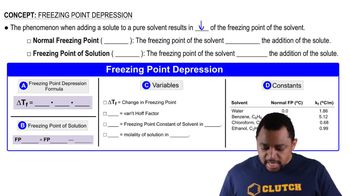
Freezing Point Depression

Freezing point depression is a colligative property that describes the lowering of a solvent's freezing point when a solute is added. The extent of this depression is directly proportional to the number of solute particles in the solution. The formula used to calculate freezing point depression is ΔTf = Kf * m, where ΔTf is the change in freezing point, Kf is the freezing point depression constant of the solvent, and m is the molality of the solution.
추천 영상:
가이드 코스
01:59
Freezing Point Depression

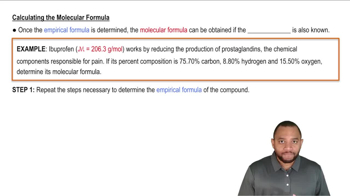
Molecular Weight Calculation

Molecular weight, or molar mass, is the mass of one mole of a substance, typically expressed in grams per mole (g/mol). To determine the molecular weight of a compound, one must first find the number of moles of solute using the freezing point depression data and the known Kf value. Once the moles are calculated, the molecular weight can be found by dividing the mass of the solute by the number of moles.
추천 영상:
가이드 코스
6:53
Molecular Formula Calculation Example

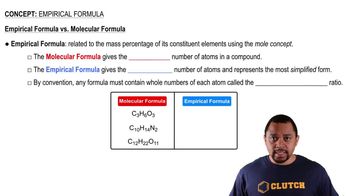
Empirical and Molecular Formulas

The empirical formula represents the simplest whole-number ratio of elements in a compound, while the molecular formula indicates the actual number of atoms of each element in a molecule. To derive the molecular formula from the empirical formula, one must determine the molar mass of the compound and compare it to the molar mass of the empirical formula. This comparison helps in identifying the factor by which the empirical formula must be multiplied to obtain the molecular formula.
추천 영상:
가이드 코스
02:26
Empirical vs Molecular Formula