The observed osmotic pressure for a 0.125 M solution of MgCl2 at 310 K is 8.57 atm. Calculate the value of the van’t Hoff factor for MgCl2 under these conditions.
검증된 단계별 안내
1
Step 1: Recall the formula for osmotic pressure, which is \( \Pi = iMRT \), where \( \Pi \) is the osmotic pressure, \( i \) is the van’t Hoff factor, \( M \) is the molarity, \( R \) is the ideal gas constant, and \( T \) is the temperature in Kelvin.
Step 2: Identify the given values from the problem: \( \Pi = 8.57 \text{ atm} \), \( M = 0.125 \text{ M} \), \( T = 310 \text{ K} \), and \( R = 0.0821 \text{ L atm K}^{-1} \text{ mol}^{-1} \).
Step 3: Rearrange the osmotic pressure formula to solve for the van’t Hoff factor \( i \): \( i = \frac{\Pi}{MRT} \).
Step 4: Substitute the known values into the rearranged formula: \( i = \frac{8.57}{0.125 \times 0.0821 \times 310} \).
Step 5: Calculate the expression to find the value of \( i \), which represents the van’t Hoff factor for MgCl_2 under the given conditions.
주요 개념
질문에 올바르게 답하기 위해 반드시 이해해야 하는 핵심 개념들은 다음과 같습니다.
Osmotic Pressure
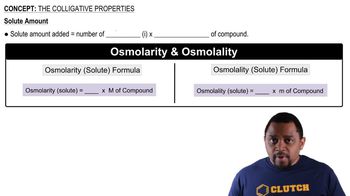
Osmotic pressure is the pressure required to prevent the flow of solvent into a solution through a semipermeable membrane. It is directly proportional to the concentration of solute particles in the solution and can be calculated using the formula π = iCRT, where π is the osmotic pressure, i is the van’t Hoff factor, C is the molarity of the solution, R is the ideal gas constant, and T is the temperature in Kelvin.
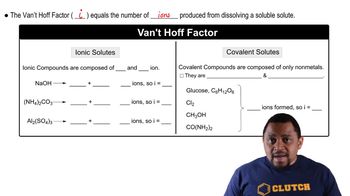
The van’t Hoff factor (i) represents the number of particles into which a solute dissociates in solution. For ionic compounds like MgCl2, which dissociates into one magnesium ion (Mg²⁺) and two chloride ions (Cl⁻), the van’t Hoff factor is 3. This factor is crucial for calculating colligative properties, including osmotic pressure, as it accounts for the total number of solute particles affecting the solution's behavior.
Colligative properties are properties of solutions that depend on the number of solute particles rather than their identity. These properties include boiling point elevation, freezing point depression, vapor pressure lowering, and osmotic pressure. Understanding colligative properties is essential for predicting how solute concentration affects the physical properties of a solution, which is key in calculating osmotic pressure and the van’t Hoff factor.


 검증된 단계별 안내
 01:13
01:13