Ch.14 - Chemical Kinetics
McMurry - Chemistry 8th Edition
McMurry8th EditionChemistryISBN: 9781292336145당신이 사용하는 게 아니라요?교과서 변경
14장, 문제 83b

Consider the following concentration–time data for the decomposition reaction AB → A + B.
(b) What is the molarity of AB after a reaction time of 192 min?

검증된 단계별 안내
1
Determine the order of the reaction by analyzing the concentration-time data.
Use the appropriate integrated rate law based on the determined order of the reaction.
Identify the initial concentration of AB from the data provided.
Substitute the initial concentration, rate constant, and time (192 min) into the integrated rate law equation.
Solve the equation for the concentration of AB at 192 min.

비슷한 문제에 대한 검증된 영상 답변:

이 영상 해법은 위 문제에 도움이 된다고 튜터들이 추천한 것입니다.
영상 길이:
10m
도움이 되었나요?

주요 개념

질문에 올바르게 답하기 위해 반드시 이해해야 하는 핵심 개념들은 다음과 같습니다.

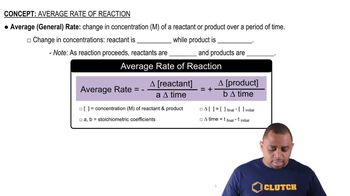
Reaction Rate

The reaction rate refers to the speed at which reactants are converted into products in a chemical reaction. It can be expressed in terms of the change in concentration of a reactant or product over time. Understanding the reaction rate is crucial for determining how the concentration of AB changes over the specified time period.
추천 영상:
가이드 코스
02:03
Average Rate of Reaction

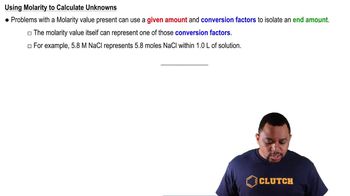
Molarity

Molarity is a measure of concentration defined as the number of moles of solute per liter of solution. It is commonly used in chemistry to express the concentration of reactants and products in a reaction. To find the molarity of AB after a certain time, one must calculate the remaining amount of AB and divide it by the total volume of the solution.
추천 영상:

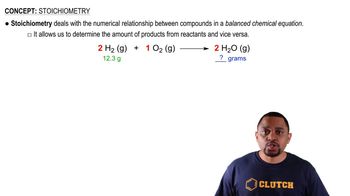
Stoichiometry

Stoichiometry involves the calculation of reactants and products in chemical reactions based on balanced chemical equations. It allows chemists to predict the amounts of substances consumed and produced. In this context, stoichiometry is essential for determining how the concentration of AB decreases as it decomposes into A and B over time.
추천 영상:
가이드 코스
01:16
Stoichiometry Concept