Ch.14 - Chemical Kinetics
McMurry - Chemistry 8th Edition
McMurry8th EditionChemistryISBN: 9781292336145당신이 사용하는 게 아니라요?교과서 변경
14장, 문제 87

Two reactions have the same activation energy, but their rates at the same temperature differ by a factor of 10. Explain.

검증된 단계별 안내
1
Understand that the rate of a chemical reaction is influenced by the activation energy and the frequency factor (A) in the Arrhenius equation: k = A * e^(-Ea/RT).
Recognize that since the activation energies (Ea) are the same for both reactions, the difference in reaction rates must be due to the frequency factor (A).
Recall that the frequency factor (A) represents the number of times that reactants approach the activation barrier per unit time, which is influenced by factors such as molecular orientation and collision frequency.
Conclude that the reaction with the higher rate constant (k) has a higher frequency factor (A), meaning that the reactants are more likely to collide in the correct orientation to overcome the activation energy barrier.
Therefore, even with the same activation energy, the difference in reaction rates by a factor of 10 is due to a difference in the frequency factors of the two reactions.

비슷한 문제에 대한 검증된 영상 답변:

이 영상 해법은 위 문제에 도움이 된다고 튜터들이 추천한 것입니다.
영상 길이:
2m
도움이 되었나요?

주요 개념

질문에 올바르게 답하기 위해 반드시 이해해야 하는 핵심 개념들은 다음과 같습니다.

Activation Energy

Activation energy is the minimum energy required for a chemical reaction to occur. It represents the energy barrier that reactants must overcome to transform into products. Even if two reactions have the same activation energy, other factors can influence their rates, such as the frequency of collisions and the orientation of reactants during those collisions.
추천 영상:
가이드 코스
02:02
Activity Series Chart

Rate of Reaction

The rate of a reaction refers to how quickly reactants are converted into products. It is influenced by several factors, including concentration, temperature, and the presence of catalysts. In this case, even with the same activation energy, differences in the rate can arise from variations in these factors, particularly the frequency of effective collisions between reactant molecules.
추천 영상:
가이드 코스
02:03
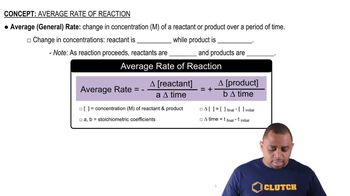
Average Rate of Reaction

Arrhenius Equation

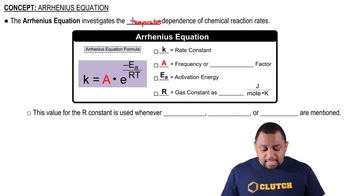
The Arrhenius equation describes the relationship between the rate constant of a reaction and temperature, incorporating activation energy. It is expressed as k = A * e^(-Ea/RT), where k is the rate constant, A is the pre-exponential factor, Ea is the activation energy, R is the gas constant, and T is the temperature in Kelvin. The pre-exponential factor can vary significantly between reactions, leading to differences in rates even when activation energies are identical.
추천 영상:
가이드 코스
01:20
Arrhenius Equation