Ch.14 - Chemical Kinetics
McMurry - Chemistry 8th Edition
McMurry8th EditionChemistryISBN: 9781292336145당신이 사용하는 게 아니라요?교과서 변경
14장, 문제 43c

The following pictures represent the progress of the reaction AS B in which A molecules (red spheres) are converted to B molecules (blue spheres).
(c) Suppose that each sphere represents 6.0⨉1021 molecules and that the volume of the container is 1.0 L. What is the rate constant for the reaction in the usual units?

검증된 단계별 안내
1
Determine the initial concentration of A molecules by counting the number of red spheres in the initial picture and multiplying by 6.0\(\times\)10^{21} to find the number of molecules. Divide by Avogadro's number to convert to moles, and then divide by the volume (1.0 L) to find the concentration in mol/L.
Determine the concentration of B molecules at a later time by counting the number of blue spheres in the later picture, multiplying by 6.0\(\times\)10^{21}, converting to moles, and dividing by the volume (1.0 L) to find the concentration in mol/L.
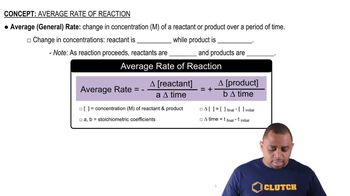
Use the change in concentration of A or B over time to calculate the rate of the reaction. The rate can be expressed as \(-\frac{\Delta [A]}{\Delta t}\) or \(\frac{\Delta [B]}{\Delta t}\), where \([A]\) and \([B]\) are the concentrations of A and B, respectively, and \(\Delta t\) is the time interval.
Assume a reaction order (e.g., first-order or second-order) based on the context or additional information provided. For a first-order reaction, the rate law is \(\text{Rate} = k[A]\), and for a second-order reaction, it is \(\text{Rate} = k[A]^2\).
Solve for the rate constant \(k\) using the rate law equation and the calculated rate and concentration values. Ensure the units of \(k\) are consistent with the assumed reaction order.

비슷한 문제에 대한 검증된 영상 답변:

이 영상 해법은 위 문제에 도움이 된다고 튜터들이 추천한 것입니다.
영상 길이:
5m

주요 개념

질문에 올바르게 답하기 위해 반드시 이해해야 하는 핵심 개념들은 다음과 같습니다.

Rate of Reaction

The rate of a chemical reaction is a measure of how quickly reactants are converted into products. It is typically expressed in terms of concentration change over time, such as moles per liter per second (mol/L/s). Understanding the rate of reaction is crucial for determining how fast the conversion of A to B occurs in the given scenario.
추천 영상:
가이드 코스
02:03
Average Rate of Reaction

Rate Constant (k)

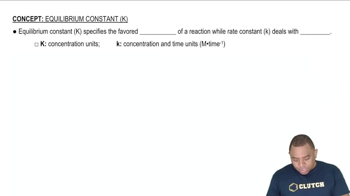
The rate constant (k) is a proportionality factor in the rate law equation that relates the rate of a reaction to the concentration of reactants. It is specific to a particular reaction at a given temperature and has units that depend on the overall order of the reaction. For a first-order reaction, the units are typically s⁻¹, while for a second-order reaction, they are L/(mol·s).
추천 영상:
가이드 코스
01:14
Equilibrium Constant K

Concentration and Molarity

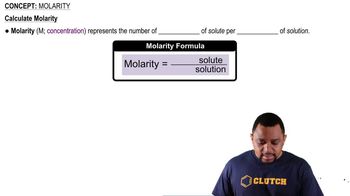
Concentration refers to the amount of a substance in a given volume of solution, commonly expressed in molarity (M), which is moles of solute per liter of solution. In this question, knowing that each sphere represents a specific number of molecules allows us to calculate the concentration of A and B in the 1.0 L container, which is essential for determining the rate constant.
추천 영상:
가이드 코스
00:53
Molarity Concept