


Ch.14 - Chemical Kinetics
McMurry - Chemistry 8th Edition
McMurry8th EditionChemistryISBN: 9781292336145당신이 사용하는 게 아니라요?교과서 변경
14장, 문제 139

The rate constant for the decomposition of gaseous NO2 to NO and O2 is 4.7>1M ~ s2 at 383 °C. Consider the decomposition of a sample of pure NO2 having an initial pressure of 746 mm Hg in a 5.00 L reaction vessel at 383 °C. (c) What is the mass of O2 in the vessel after a reaction time of 1.00 min?

검증된 단계별 안내
1
Convert the initial pressure of NO2 from mm Hg to atm using the conversion factor 1 atm = 760 mm Hg.
Use the ideal gas law, PV = nRT, to calculate the initial moles of NO2 in the reaction vessel. Remember to use the appropriate units for R (0.0821 L atm / mol K) and convert the temperature to Kelvin.
Determine the change in moles of NO2 over the reaction time using the rate constant and the integrated rate law for a first-order reaction: ln([NO2]0/[NO2]t) = kt.
Calculate the moles of O2 produced using the stoichiometry of the balanced chemical equation: 2 NO2 -> 2 NO + O2.
Convert the moles of O2 to mass using the molar mass of O2 (32.00 g/mol).

비슷한 문제에 대한 검증된 영상 답변:

이 영상 해법은 위 문제에 도움이 된다고 튜터들이 추천한 것입니다.
영상 길이:
10m

주요 개념

질문에 올바르게 답하기 위해 반드시 이해해야 하는 핵심 개념들은 다음과 같습니다.

Rate Constant and Reaction Order

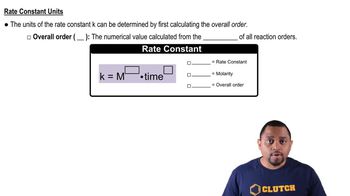
The rate constant (k) is a proportionality factor in the rate law of a chemical reaction, indicating how the rate of reaction depends on the concentration of reactants. The units of k vary with the order of the reaction; for a second-order reaction, the units are typically M^-1 s^-1. Understanding the reaction order helps in determining how the concentration of reactants affects the rate of product formation over time.
추천 영상:
가이드 코스
00:45
Rate Constant Units

Ideal Gas Law

The Ideal Gas Law (PV = nRT) relates the pressure (P), volume (V), number of moles (n), gas constant (R), and temperature (T) of a gas. This law is essential for converting between pressure and moles, especially when calculating the amount of gas produced or consumed in a reaction. In this context, it will help determine the moles of O2 produced from the decomposition of NO2.
추천 영상:
가이드 코스
01:15
Ideal Gas Law Formula

Stoichiometry of the Reaction

Stoichiometry involves the quantitative relationships between reactants and products in a chemical reaction. For the decomposition of NO2 into NO and O2, the balanced equation shows that 2 moles of NO2 produce 1 mole of O2. This relationship is crucial for calculating the mass of O2 produced after a specific reaction time, as it allows for the conversion of moles of NO2 reacted to moles of O2 formed.
추천 영상:
가이드 코스
01:16
Stoichiometry Concept
관련 실천
교과서 질문
For the thermal decomposition of nitrous oxide, 2 N2O1g2S 2 N21g2 + O21g2, values of the parameters in the Arrhenius equation are A = 4.2 * 109 s-1 and Ea = 222 kJ>mol. If a stream of N2O is passed through a tube 25 mm in diameter and 20 cm long at a flow rate of 0.75 L/min at what temperature should the tube be maintained to have a partial pressure of 1.0 mm of O2 in the exit gas? Assume that the total pressure of the gas in the tube is 1.50 atm.
867
views
교과서 질문
A 1.50 L sample of gaseous HI having a density of 0.0101 g>cm3 is heated at 410 °C. As time passes, the HI decomposes to gaseous H2 and I2. The rate law is -Δ3HI4>Δt = k3HI42, where k = 0.031>1M ~ min2 at 410 °C. (b) What is the partial pressure of H2 after a reaction time of 8.00 h?
403
views
교과서 질문

The rate constant for the first-order decomposition of gaseous N2O5 to NO2 and O2 is 1.7 * 10-3 s-1 at 55 °C. (a) If 2.70 g of gaseous N2O5 is introduced into an evacuated 2.00 L container maintained at a constant temperature of 55 °C, what is the total pressure in the container after a reaction time of 13.0 minutes?

882
views
1
comments
교과서 질문

Values of Ea = 6.3 kJ/mol and A = 6.0⨉108/(M s) have been measured for the bimolecular reaction: NO(g) + F2(g) → NOF(g) + F(g) (a) Calculate the rate constant at 25 °C.

534
views
교과서 질문

The rate constant for the first-order decomposition of gaseous N2O5 to NO2 and O2 is 1.7 * 10-3 s-1 at 55 °C. (b) Use the data in Appendix B to calculate the initial rate at which the reaction mixture absorbs heat (in J/s). You may assume that the heat of the reaction is independent of temperature.

502
views
교과서 질문

Values of Ea = 6.3 kJ/mol and A = 6.0⨉108/(M s) have been measured for the bimolecular reaction: NO(g) + F2(g) → NOF(g) + F(g) (d) Why does the reaction have such a low activation energy?

267
views