
Ch.14 - Chemical Kinetics
McMurry - Chemistry 8th Edition
McMurry8th EditionChemistryISBN: 9781292336145당신이 사용하는 게 아니라요?교과서 변경
14장, 문제 105

What distinguishes the rate-determining step from the other steps in a reaction mechanism? How does the ratedetermining step affect the observed rate law?

검증된 단계별 안내
1
Understand that a reaction mechanism is composed of a series of elementary steps, each with its own rate, which together describe how the overall reaction occurs.
Identify the rate-determining step (RDS) as the slowest step in the reaction mechanism. This step has the highest activation energy barrier to overcome compared to other steps in the mechanism.
Recognize that because the rate-determining step is the slowest, it limits the rate at which the overall reaction proceeds. The overall reaction cannot proceed faster than this slowest step.
Learn that the rate law of the overall reaction is determined by the rate-determining step. The molecularity and the concentration of reactants involved in the RDS dictate the form of the rate law.
Apply the concept that the coefficients of reactants in the rate law are derived from the stoichiometry of the rate-determining step, not necessarily from the overall balanced equation of the reaction.

비슷한 문제에 대한 검증된 영상 답변:

이 영상 해법은 위 문제에 도움이 된다고 튜터들이 추천한 것입니다.
영상 길이:
2m
도움이 되었나요?

주요 개념

질문에 올바르게 답하기 위해 반드시 이해해야 하는 핵심 개념들은 다음과 같습니다.

Rate-Determining Step

The rate-determining step (RDS) is the slowest step in a reaction mechanism that limits the overall rate of the reaction. It is the step with the highest activation energy, meaning it requires the most energy to proceed. Because the RDS is the bottleneck of the reaction pathway, the rate of the entire reaction is primarily determined by this step.
추천 영상:
가이드 코스
01:15
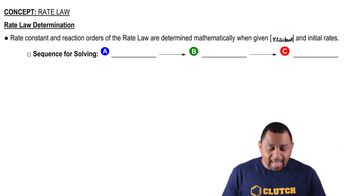
Rate Law Determination

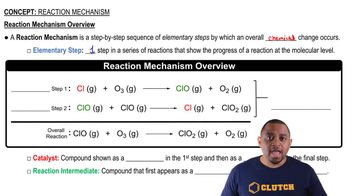
Reaction Mechanism

A reaction mechanism is a detailed description of the individual steps that occur during a chemical reaction. Each step involves the breaking and forming of bonds and can vary in speed. Understanding the mechanism helps chemists predict how changes in conditions (like concentration or temperature) will affect the reaction rate and the overall process.
추천 영상:
가이드 코스
03:06
Reaction Mechanism Overview

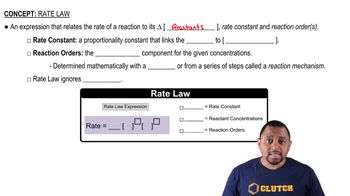
Rate Law

The rate law is an equation that relates the rate of a chemical reaction to the concentration of its reactants. It is derived from the stoichiometry of the rate-determining step, where the rate is proportional to the concentrations of the reactants raised to their respective powers. The rate law provides insight into the relationship between the reaction mechanism and the observed reaction rate, highlighting the influence of the RDS.
추천 영상:
가이드 코스
01:52
Rate Law Fundamentals