
Ch.14 - Chemical Kinetics
McMurry - Chemistry 8th Edition
McMurry8th EditionChemistryISBN: 9781292336145당신이 사용하는 게 아니라요?교과서 변경
14장, 문제 104

What is the relationship between the coefficients in a balanced chemical equation for an overall reaction and the exponents in the rate law?

검증된 단계별 안내
1
Understand that the coefficients in a balanced chemical equation represent the stoichiometry of the reaction, indicating the relative amounts of reactants and products involved in the reaction.
Recognize that the rate law of a reaction expresses the rate of the reaction as a function of the concentration of the reactants, where the exponents on the reactant concentrations are the reaction orders.
Acknowledge that the coefficients in the balanced equation and the exponents in the rate law are generally not the same. The coefficients are determined by the stoichiometry of the reaction, while the exponents are determined experimentally and reflect the mechanism of the reaction.
Learn that the rate law can only be determined through experiments and cannot be directly inferred from the balanced chemical equation alone. The reaction mechanism, which may involve intermediate steps not apparent in the overall balanced equation, plays a crucial role in determining the form of the rate law.
Explore examples and perform experiments to see how changes in reactant concentrations affect the rate of the reaction, and use this data to determine the order of each reactant in the rate law.

비슷한 문제에 대한 검증된 영상 답변:

이 영상 해법은 위 문제에 도움이 된다고 튜터들이 추천한 것입니다.
영상 길이:
3m
도움이 되었나요?

주요 개념

질문에 올바르게 답하기 위해 반드시 이해해야 하는 핵심 개념들은 다음과 같습니다.

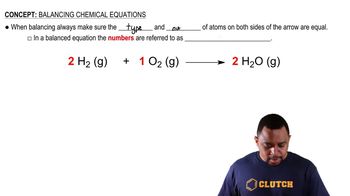
Balanced Chemical Equations

A balanced chemical equation represents a chemical reaction where the number of atoms for each element is conserved. The coefficients in the equation indicate the relative amounts of reactants and products involved in the reaction. This balance is crucial for understanding stoichiometry, which relates to how substances react in fixed proportions.
추천 영상:
가이드 코스
01:32
Balancing Chemical Equations

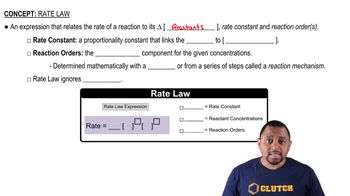
Rate Law

The rate law expresses the relationship between the rate of a chemical reaction and the concentration of its reactants. It is typically formulated as rate = k[A]^m[B]^n, where k is the rate constant, and m and n are the reaction orders corresponding to reactants A and B. The exponents in the rate law indicate how the rate is affected by changes in concentration, which may not directly correspond to the coefficients in the balanced equation.
추천 영상:
가이드 코스
01:52
Rate Law Fundamentals

Reaction Order

Reaction order is a concept that describes the dependence of the reaction rate on the concentration of reactants. It is determined experimentally and can be a whole number, fraction, or zero. While the coefficients in a balanced equation suggest stoichiometric relationships, the reaction order reflects the actual mechanism of the reaction, which may involve intermediates or complex pathways that do not align with simple stoichiometry.
추천 영상:
가이드 코스
00:36
Average Bond Order