Ch.14 - Chemical Kinetics
McMurry - Chemistry 8th Edition
McMurry8th EditionChemistryISBN: 9781292336145당신이 사용하는 게 아니라요?교과서 변경
14장, 문제 80

You wish to determine the reaction order and rate constant for the following thermal decomposition reaction: AB2 S 1>2 A2 + B2 (c) Describe how you would determine the value of the rate constant.

검증된 단계별 안내
1
Start by identifying the reaction given: AB_2 \(\rightarrow\) \(\frac{1}{2}\) A_2 + B_2. The reaction order can be determined experimentally by measuring how the concentration of AB_2 changes over time.
The rate law for a reaction is generally expressed as rate = k [AB_2]^n, where k is the rate constant and n is the order of the reaction with respect to AB_2.
Perform a series of experiments to measure the concentration of AB_2 at various times. This data will help you determine the reaction order and rate constant.
Use the method of initial rates or integrate the rate law to find the reaction order. For example, if the reaction is first-order, a plot of ln[AB_2] versus time will yield a straight line, and the slope will be -k.
Once the reaction order is known, use the slope from the appropriate plot (e.g., ln[AB_2] vs. time for first-order) to calculate the rate constant k.>

비슷한 문제에 대한 검증된 영상 답변:

이 영상 해법은 위 문제에 도움이 된다고 튜터들이 추천한 것입니다.
영상 길이:
4m

주요 개념

질문에 올바르게 답하기 위해 반드시 이해해야 하는 핵심 개념들은 다음과 같습니다.

Reaction Order

The reaction order is a key concept in chemical kinetics that indicates the relationship between the concentration of reactants and the rate of the reaction. It is determined experimentally and can be zero, first, second, or higher order, depending on how the rate changes with varying concentrations. For the given reaction, understanding the order helps in formulating the rate law, which is essential for calculating the rate constant.
추천 영상:
가이드 코스
00:36
Average Bond Order

Rate Law

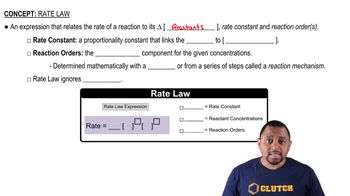
The rate law expresses the rate of a chemical reaction as a function of the concentration of its reactants, each raised to a power corresponding to its order in the reaction. For the decomposition of AB2, the rate law can be written as rate = k[AB2]^n, where k is the rate constant and n is the reaction order. Determining the rate law is crucial for finding the rate constant through experimental data.
추천 영상:
가이드 코스
01:52
Rate Law Fundamentals

Arrhenius Equation

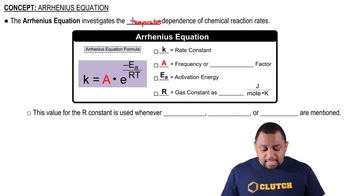
The Arrhenius equation relates the rate constant (k) of a reaction to the temperature (T) and activation energy (Ea) of the reaction. It is expressed as k = A * e^(-Ea/RT), where A is the pre-exponential factor, R is the gas constant, and T is the temperature in Kelvin. This equation is vital for determining the rate constant at different temperatures and understanding how temperature influences reaction rates.
추천 영상:
가이드 코스
01:20
Arrhenius Equation