15.104 Consider the reaction C(s) + CO2(g) ⇌ 2 CO(g). When 1.50 mol of CO2 and an excess of solid carbon are heated in a 20.0-L container at 1100 K, the equilibrium concentration of CO is 7.00 x 10^-2 M. (a) What is the equilibrium concentration of CO2? (b) What is the value of the equilibrium constant Kc at 1100 K?
검증된 단계별 안내
1
Step 1: Write the balanced chemical equation for the reaction: C(s) + CO_2(g) ⇌ 2 CO(g).
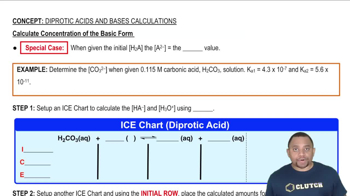
Step 2: Use the information given to set up an ICE (Initial, Change, Equilibrium) table. Initially, you have 1.50 mol of CO_2 in a 20.0 L container, so the initial concentration of CO_2 is 1.50 mol / 20.0 L. The initial concentration of CO is 0 M.
Step 3: Define the change in concentration for CO_2 and CO. Let x be the change in concentration of CO_2 that reacts. Since the stoichiometry of the reaction shows that 1 mol of CO_2 produces 2 mol of CO, the change in concentration of CO will be 2x.
Step 4: Use the equilibrium concentration of CO, which is given as 7.00 x 10^-2 M, to find x. Since the change in concentration of CO is 2x, set 2x equal to 7.00 x 10^-2 M and solve for x.
Step 5: Calculate the equilibrium concentration of CO_2 using the initial concentration and the change in concentration (x). Then, use the equilibrium concentrations of CO and CO_2 to calculate the equilibrium constant K_c using the expression K_c = [CO]^2 / [CO_2].
주요 개념
질문에 올바르게 답하기 위해 반드시 이해해야 하는 핵심 개념들은 다음과 같습니다.
Chemical Equilibrium
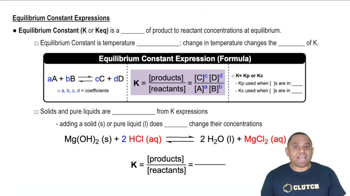
Chemical equilibrium occurs when the rates of the forward and reverse reactions are equal, resulting in constant concentrations of reactants and products. In this state, the system is dynamic, meaning that reactions continue to occur, but there is no net change in concentration. Understanding this concept is crucial for analyzing how changes in conditions affect the concentrations of substances in a reaction.
The equilibrium constant (Kc) is a numerical value that expresses the ratio of the concentrations of products to reactants at equilibrium, each raised to the power of their coefficients in the balanced equation. It provides insight into the position of equilibrium; a large Kc indicates a reaction that favors products, while a small Kc suggests reactants are favored. Calculating Kc is essential for understanding the extent of a reaction under specific conditions.
Concentration calculations involve determining the molarity of a substance in a solution, defined as the number of moles of solute per liter of solution. In equilibrium problems, it is important to calculate the initial and equilibrium concentrations of reactants and products to apply the equilibrium expression correctly. This concept is fundamental for solving for unknown concentrations in equilibrium scenarios.


 검증된 단계별 안내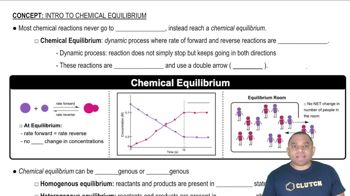
 04:21
04:21