
Ch.15 - Chemical Equilibrium
McMurry - Chemistry 8th Edition
McMurry8th EditionChemistryISBN: 9781292336145당신이 사용하는 게 아니라요?교과서 변경
15장, 문제 98

At 700 K, Kp = 0.140 for the reaction ClF₃(g) ⇌ ClF(g) + F₂(g). Calculate the equilibrium partial pressures of ClF₃, ClF, and F₂ if only ClF₃ is present initially, at a partial pressure of 1.47 atm.

검증된 단계별 안내
1
Identify the initial conditions: Only ClF₃ is present initially with a partial pressure of 1.47 atm, and the partial pressures of ClF and F₂ are 0 atm.
Write the expression for the equilibrium constant Kp for the reaction: Kp = (P_{ClF} * P_{F2}) / P_{ClF3}.
Define the change in partial pressures: Let the change in partial pressure of ClF₃ be -x atm, then the change for ClF and F₂ will be +x atm each, due to the stoichiometry of the reaction.
Express the equilibrium partial pressures in terms of x: P_{ClF3} = 1.47 - x, P_{ClF} = x, and P_{F2} = x.
Substitute the equilibrium partial pressures into the Kp expression and solve for x: 0.140 = (x * x) / (1.47 - x).

주요 개념

질문에 올바르게 답하기 위해 반드시 이해해야 하는 핵심 개념들은 다음과 같습니다.

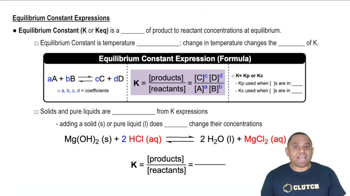
Equilibrium Constant (Kp)

The equilibrium constant (Kp) is a numerical value that expresses the ratio of the partial pressures of the products to the reactants at equilibrium for a given reaction at a specific temperature. For the reaction ClF₃(g) ⇌ ClF(g) + F₂(g), Kp = 0.140 indicates that at equilibrium, the ratio of the partial pressures of ClF and F₂ to that of ClF₃ is constant. This concept is crucial for determining the equilibrium state of the system.
추천 영상:
가이드 코스
03:20
Equilibrium Constant Expressions

Initial Conditions and Changes at Equilibrium

In this problem, we start with an initial partial pressure of ClF₃ at 1.47 atm and no products present. As the reaction proceeds towards equilibrium, the partial pressures of ClF₃ will decrease while those of ClF and F₂ will increase. Understanding how to set up the initial conditions and the changes that occur as the system reaches equilibrium is essential for calculating the final partial pressures.
추천 영상:
가이드 코스
02:35
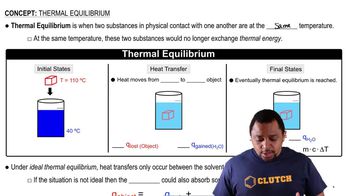
Thermal Equilibrium

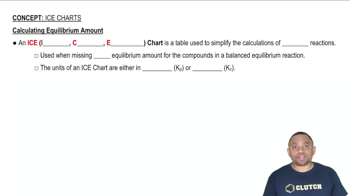
ICE Table (Initial, Change, Equilibrium)

An ICE table is a tool used to organize the initial concentrations (or pressures), the changes that occur as the reaction proceeds, and the equilibrium concentrations (or pressures). For this reaction, the table will help track the initial pressure of ClF₃, the decrease in its pressure, and the corresponding increases in the pressures of ClF and F₂. This systematic approach is vital for solving equilibrium problems accurately.
추천 영상:
가이드 코스
01:14
ICE Charts and Equilibrium Amount