
Ch.15 - Chemical Equilibrium
McMurry - Chemistry 8th Edition
McMurry8th EditionChemistryISBN: 9781292336145당신이 사용하는 게 아니라요?교과서 변경
15장, 문제 97

In a basic aqueous solution, chloromethane undergoes a substitution reaction in which Cl- is replaced by OH-: CH3Cl(aq) + OH-(aq) ⇌ CH3OH(aq) + Cl-(aq). The equilibrium constant Kc is 1 * 10^16. Calculate the equilibrium concentrations of CH3Cl, CH3OH, OH-, and Cl- in a solution prepared by mixing equal volumes of 0.1 M CH3Cl and 0.2 M NaOH. (Hint: In defining x, assume that the reaction goes 100% to completion, and then take account of a small amount of the reverse reaction.)

검증된 단계별 안내
1
Step 1: Write the balanced chemical equation for the reaction: \( \text{CH}_3\text{Cl} + \text{OH}^- \rightleftharpoons \text{CH}_3\text{OH} + \text{Cl}^- \).
Step 2: Determine the initial concentrations of the reactants. Since equal volumes of 0.1 M \( \text{CH}_3\text{Cl} \) and 0.2 M \( \text{NaOH} \) are mixed, the initial concentration of \( \text{CH}_3\text{Cl} \) is 0.05 M and \( \text{OH}^- \) is 0.1 M after mixing.
Step 3: Assume the reaction goes to completion initially, meaning all \( \text{CH}_3\text{Cl} \) is converted to \( \text{CH}_3\text{OH} \). Calculate the concentrations at this point: \( [\text{CH}_3\text{OH}] = 0.05 \text{ M} \) and \( [\text{Cl}^-] = 0.05 \text{ M} \).
Step 4: Define \( x \) as the small amount of \( \text{CH}_3\text{OH} \) that reverts back to \( \text{CH}_3\text{Cl} \) and \( \text{OH}^- \). Set up the equilibrium expressions: \( [\text{CH}_3\text{Cl}] = x \), \( [\text{CH}_3\text{OH}] = 0.05 - x \), \( [\text{OH}^-] = 0.1 - x \), \( [\text{Cl}^-] = 0.05 + x \).
Step 5: Use the equilibrium constant expression \( K_c = \frac{[\text{CH}_3\text{OH}][\text{Cl}^-]}{[\text{CH}_3\text{Cl}][\text{OH}^-]} = 1 \times 10^{16} \) to solve for \( x \). Substitute the expressions from Step 4 into the equilibrium constant expression and solve for \( x \).

주요 개념

질문에 올바르게 답하기 위해 반드시 이해해야 하는 핵심 개념들은 다음과 같습니다.

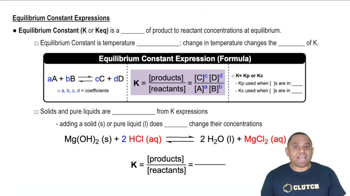
Equilibrium Constant (Kc)

The equilibrium constant, Kc, quantifies the ratio of the concentrations of products to reactants at equilibrium for a reversible reaction. In this case, Kc = [CH3OH][Cl-] / [CH3Cl][OH-]. A large Kc value, such as 1 * 10^16, indicates that at equilibrium, the products are favored, suggesting that the reaction proceeds almost to completion.
추천 영상:
가이드 코스
03:20
Equilibrium Constant Expressions

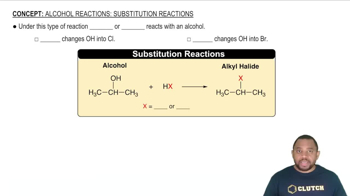
Substitution Reaction

A substitution reaction involves the replacement of one functional group in a molecule with another. In this scenario, chloromethane (CH3Cl) undergoes nucleophilic substitution where the chloride ion (Cl-) is replaced by the hydroxide ion (OH-), resulting in the formation of methanol (CH3OH). Understanding this mechanism is crucial for predicting the products and the direction of the reaction.
추천 영상:
가이드 코스
01:08
Alcohol Reactions: Substitution Reactions

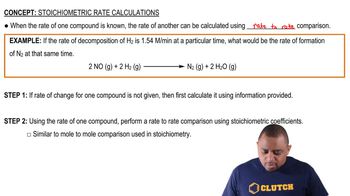
Stoichiometry and Concentration Calculations

Stoichiometry involves the calculation of reactants and products in chemical reactions based on their molar ratios. In this problem, the initial concentrations of CH3Cl and NaOH must be considered to determine the changes in concentration as the reaction proceeds. By assuming the reaction goes to completion and then accounting for the reverse reaction, one can calculate the equilibrium concentrations of all species involved.
추천 영상:
가이드 코스
02:28
Stoichiometric Rate Calculations