Ch.15 - Chemical Equilibrium
McMurry - Chemistry 8th Edition
McMurry8th EditionChemistryISBN: 9781292336145당신이 사용하는 게 아니라요?교과서 변경
15장, 문제 117

Calculate the equilibrium concentrations of H2O(g), Cl2(g), HCl(g), and O2(g) at 298 K if the initial concentrations are [H2O] = 0.050 M and [Cl2] = 0.100 M. The equilibrium constant Kc for the reaction H2O(g) + Cl2(g) ⇌ 2 HCl(g) + O2(g) is 8.96 × 10^-9 at 298 K.

검증된 단계별 안내
1
Write the balanced chemical equation for the reaction: H2O(g) + Cl2(g) ⇌ 2 HCl(g) + O2(g).
Set up an ICE (Initial, Change, Equilibrium) table to track the concentrations of each species. Initially, [H2O] = 0.050 M, [Cl2] = 0.100 M, and [HCl] and [O2] are 0 M.
Define the change in concentration for the reactants and products in terms of x, where x is the amount of H2O and Cl2 that reacts. The changes will be: -x for H2O and Cl2, +2x for HCl, and +x for O2.
Express the equilibrium concentrations in terms of x: [H2O] = 0.050 - x, [Cl2] = 0.100 - x, [HCl] = 2x, and [O2] = x.
Substitute these expressions into the equilibrium constant expression Kc = ([HCl]^2[O2])/([H2O][Cl2]) and solve for x using the given Kc value of 8.96 × 10^-9.

주요 개념

질문에 올바르게 답하기 위해 반드시 이해해야 하는 핵심 개념들은 다음과 같습니다.

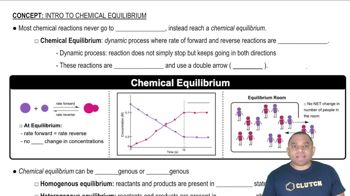
Chemical Equilibrium

Chemical equilibrium occurs when the rates of the forward and reverse reactions are equal, resulting in constant concentrations of reactants and products. In this state, the system is dynamic, meaning that reactions continue to occur, but there is no net change in concentration. Understanding this concept is crucial for calculating equilibrium concentrations, as it allows us to apply the equilibrium constant (Kc) to the reaction.
추천 영상:
가이드 코스
04:21
Chemical Equilibrium Concepts

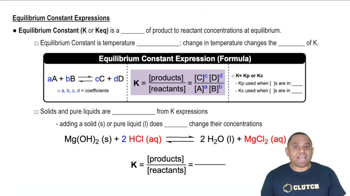
Equilibrium Constant (Kc)

The equilibrium constant (Kc) is a numerical value that expresses the ratio of the concentrations of products to reactants at equilibrium, each raised to the power of their coefficients in the balanced equation. For the reaction H2O(g) + Cl2(g) ⇌ 2 HCl(g) + O2(g), Kc = [HCl]^2[O2] / [H2O][Cl2]. This constant provides insight into the position of equilibrium and is essential for calculating the equilibrium concentrations from initial concentrations.
추천 영상:
가이드 코스
03:20
Equilibrium Constant Expressions

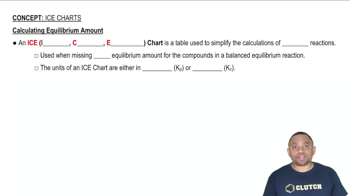
ICE Table (Initial, Change, Equilibrium)

An ICE table is a tool used to organize the initial concentrations, the changes in concentrations as the reaction proceeds, and the equilibrium concentrations of all species involved in a chemical reaction. By setting up an ICE table for the given reaction, one can systematically determine how the initial concentrations of H2O and Cl2 change to reach equilibrium, allowing for the calculation of the final concentrations of all species.
추천 영상:
가이드 코스
01:14
ICE Charts and Equilibrium Amount