
Ch.15 - Chemical Equilibrium
McMurry - Chemistry 8th Edition
McMurry8th EditionChemistryISBN: 9781292336145당신이 사용하는 게 아니라요?교과서 변경
15장, 문제 136

Consider a general, single-step reaction of the type A + B ∆ C. Show that the equilibrium constant is equal to the ratio of the rate constants for the forward and reverse reactions, Kc = kf>kr.

검증된 단계별 안내
1
Identify the forward and reverse reactions: In the given reaction A + B ⇄ C, the forward reaction is A + B → C, and the reverse reaction is C → A + B.
Define the rate constants: Let kf be the rate constant for the forward reaction and kr for the reverse reaction.
Write the rate expressions for both reactions: The rate of the forward reaction can be expressed as rate_forward = kf[A][B], and the rate of the reverse reaction as rate_reverse = kr[C].
Set up the equilibrium condition: At equilibrium, the rate of the forward reaction equals the rate of the reverse reaction. Therefore, kf[A][B] = kr[C].
Solve for the equilibrium constant, Kc: Rearrange the equilibrium condition to find Kc = \(\frac{kf}{kr}\). This shows that the equilibrium constant for the reaction is indeed the ratio of the rate constants of the forward and reverse reactions.

비슷한 문제에 대한 검증된 영상 답변:

이 영상 해법은 위 문제에 도움이 된다고 튜터들이 추천한 것입니다.
영상 길이:
4m
도움이 되었나요?

주요 개념

질문에 올바르게 답하기 위해 반드시 이해해야 하는 핵심 개념들은 다음과 같습니다.

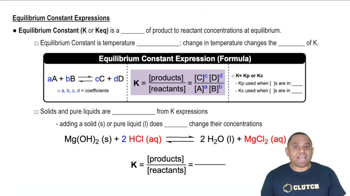
Equilibrium Constant (Kc)

The equilibrium constant (Kc) is a dimensionless value that expresses the ratio of the concentrations of products to reactants at equilibrium for a given reaction at a specific temperature. For the reaction A + B ⇌ C, Kc is defined as [C]/([A][B]), indicating the extent to which the reaction favors products or reactants at equilibrium.
추천 영상:
가이드 코스
03:20
Equilibrium Constant Expressions

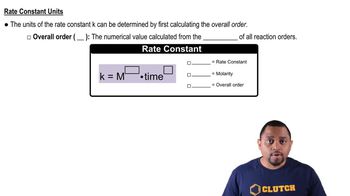
Rate Constants (kf and kr)

Rate constants (kf for the forward reaction and kr for the reverse reaction) quantify the speed of a reaction. They are specific to each reaction and depend on factors such as temperature and activation energy. The relationship between these constants is crucial for understanding how quickly reactants convert to products and vice versa.
추천 영상:
가이드 코스
00:45
Rate Constant Units

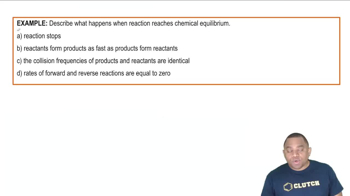
Reaction Dynamics and Equilibrium

In a dynamic equilibrium, the rates of the forward and reverse reactions are equal, leading to constant concentrations of reactants and products. This balance allows us to relate the equilibrium constant to the rate constants, as Kc = kf/kr, demonstrating that the position of equilibrium is influenced by the relative speeds of the forward and reverse processes.
추천 영상:
가이드 코스
01:18
Chemical Equilibrium Example
관련 실천
교과서 질문
In automobile catalytic converters, the air pollutant nitric oxide is converted to nitrogen and oxygen. Listed in the table are forward and reverse rate constants for the reac- tion 2 NO1g2 ∆ N21g2 + O21g2. Temperature (K) kf1M — 1 s-12 kr1M-1 s — 12 1400 0.29 1.1 * 10-6 1500 1.3 1.4 * 10-5 Is the reaction endothermic or exothermic? Explain in terms of kinetics.
429
views
교과서 질문
Which of the following relative values of kf and kr results in an equilibrium mixture that contains large amounts of reactants and small amounts of products? (a) kf 7 kr (b) kf = kr (c) kf 6 kr
1058
views
교과서 질문
Consider the reaction of chloromethane with OH- in aque- ous solution: CH Cl1aq2 + OH-1aq2 ∆kf CH OH1aq2 + Cl-1aq2 At 25 °C, the rate constant for the forward reaction is 6 * 10-6 M-1 s-1, and the equilibrium constant Kc is 1 * 1016. Calculate the rate constant for the reverse reac- tion at 25 °C.
380
views
교과서 질문
A platinum catalyst is used in automobile catalytic convert- ers to hasten the oxidation of carbon monoxide: 2 CO1g2 + O 1g2 ∆Pt 2 CO 1g2 ΔH° = - 566 kJ Suppose that you have a reaction vessel containing an equilibrium mixture of CO1g2, O21g2, and CO21g2. Under the following conditions, will the amount of CO increase, decrease, or remain the same? (e) The pressure is increased by adding O2 gas.
496
views
교과서 질문
For the reaction A2 + 2B ∆ 2 AB, the rate of the for- ward reaction is 18 M/s and the rate of the reverse reaction is 12 M/s. The reaction is not at equilibrium. Will the reaction pro- ceed in the forward or reverse direction to attain equilibrium?
788
views