In automobile catalytic converters, the air pollutant nitric oxide is converted to nitrogen and oxygen. Listed in the table are forward and reverse rate constants for the reac- tion 2 NO1g2 ∆ N21g2 + O21g2. Temperature (K) kf1M — 1 s-12 kr1M-1 s — 12
1400 0.29 1.1 * 10-6
1500 1.3 1.4 * 10-5
Is the reaction endothermic or exothermic? Explain in terms of kinetics.
검증된 단계별 안내
1
Step 1: Understand the concept of endothermic and exothermic reactions. An endothermic reaction absorbs heat from the surroundings, while an exothermic reaction releases heat to the surroundings.
Step 2: Look at the rate constants for the forward and reverse reactions at different temperatures. If the rate constant for the forward reaction increases more rapidly with temperature than the reverse reaction, the reaction is endothermic. If the rate constant for the reverse reaction increases more rapidly with temperature than the forward reaction, the reaction is exothermic.
Step 3: Compare the rate constants for the forward and reverse reactions at 1400 K and 1500 K. The forward rate constant increases from 0.29 to 1.3, while the reverse rate constant increases from 1.1 * 10^-6 to 1.4 * 10^-5.
Step 4: Determine which rate constant increases more rapidly with temperature. In this case, the forward rate constant increases more rapidly than the reverse rate constant.
Step 5: Based on the comparison in step 4, we can conclude that the reaction is endothermic because the rate constant for the forward reaction increases more rapidly with temperature than the reverse reaction. This indicates that the reaction absorbs heat from the surroundings.
비슷한 문제에 대한 검증된 영상 답변:
이 영상 해법은 위 문제에 도움이 된다고 튜터들이 추천한 것입니다.
영상 길이:
3m
영상 재생:
0 댓글
주요 개념
질문에 올바르게 답하기 위해 반드시 이해해야 하는 핵심 개념들은 다음과 같습니다.
Reaction Kinetics
Reaction kinetics studies the rates of chemical reactions and the factors that affect these rates. It involves understanding how the concentration of reactants and products changes over time, and how temperature, catalysts, and other conditions influence these rates. In the context of the given question, the forward and reverse rate constants at different temperatures provide insight into the reaction dynamics.
In a chemical reaction at equilibrium, the rate of the forward reaction equals the rate of the reverse reaction. The equilibrium constant (K) can be expressed in terms of the rate constants (kf and kr) for the forward and reverse reactions. By analyzing the temperature dependence of these rate constants, one can infer whether the reaction favors products or reactants, which is crucial for determining if the reaction is endothermic or exothermic.
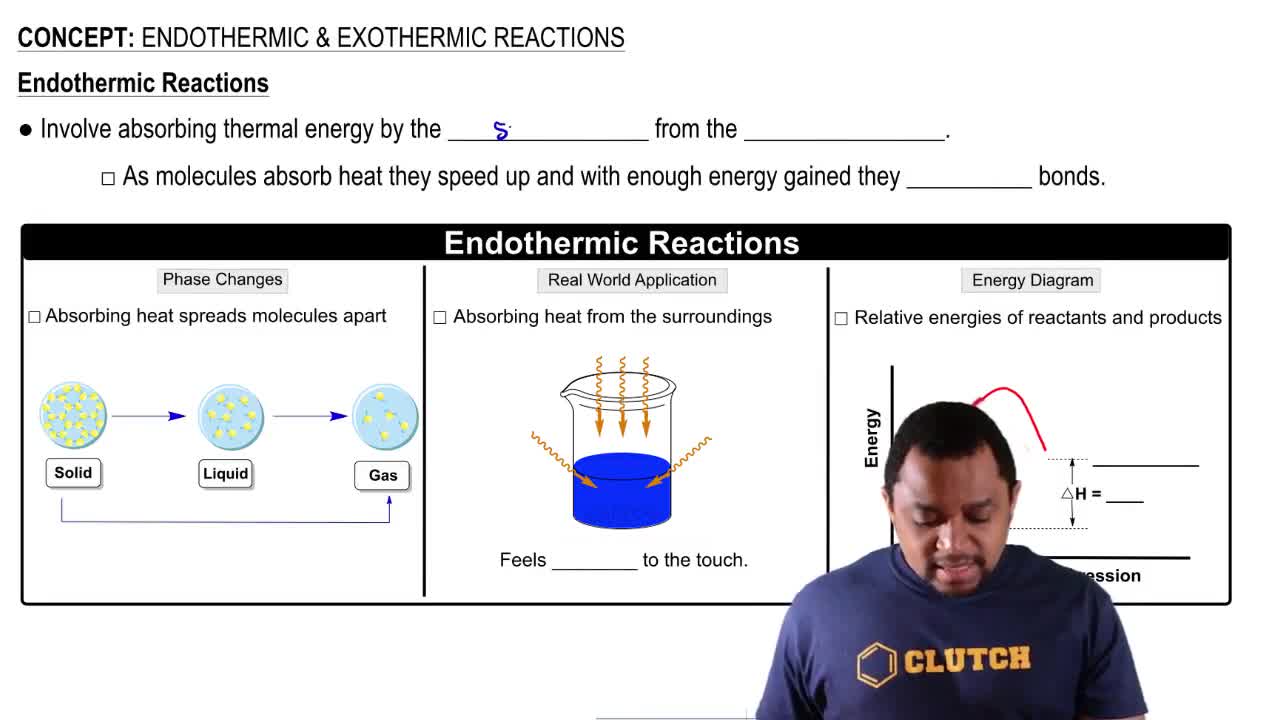
Endothermic reactions absorb heat from their surroundings, resulting in a decrease in temperature, while exothermic reactions release heat, increasing the temperature. The temperature dependence of the rate constants can indicate the nature of the reaction; if the forward rate constant increases significantly with temperature, it suggests that the reaction requires heat input, characteristic of an endothermic process.


 검증된 단계별 안내
 03:06
03:06