
Ch.15 - Chemical Equilibrium
McMurry - Chemistry 8th Edition
McMurry8th EditionChemistryISBN: 9781292336145당신이 사용하는 게 아니라요?교과서 변경
15장, 문제 75

For each of the following equilibria, write the equilibrium constant expression for Kc. Where appropriate, also write the equilibrium constant expression for Kp. (a) WO3(s) + 3 H2(g) ⇌ W(s) + 3 H2O(g) (b) Ag+(aq) + Cl-(aq) ⇌ AgCl(s) (c) 2 FeCl3(s) + 3 H2O(g) ⇌ Fe2O3(s) + 6 HCl(g) (d) MgCO3(s) ⇌ MgO(s) + CO2(g)

검증된 단계별 안내
1
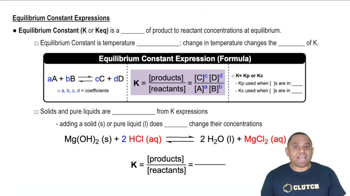
Step 1: Understand the concept of equilibrium constant expressions. For a general reaction aA + bB ⇌ cC + dD, the equilibrium constant expression for Kc is given by: Kc = [C]^c [D]^d / [A]^a [B]^b, where [X] denotes the concentration of species X.
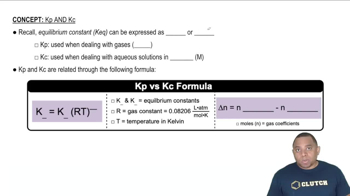
Step 2: For reactions involving gases, the equilibrium constant can also be expressed in terms of partial pressures, Kp. The relationship between Kc and Kp is given by: Kp = Kc(RT)^Δn, where Δn is the change in moles of gas (moles of gaseous products - moles of gaseous reactants), R is the ideal gas constant, and T is the temperature in Kelvin.
Step 3: For reaction (a) WO3(s) + 3 H2(g) ⇌ W(s) + 3 H2O(g), write the Kc expression considering only the gaseous species: Kc = [H2O]^3 / [H2]^3. Since there is a change in moles of gas (Δn = 0), Kp = Kc.
Step 4: For reaction (b) Ag+(aq) + Cl-(aq) ⇌ AgCl(s), write the Kc expression considering only the aqueous species: Kc = 1 / [Ag+][Cl-]. Since there are no gaseous species, Kp is not applicable.
Step 5: For reaction (c) 2 FeCl3(s) + 3 H2O(g) ⇌ Fe2O3(s) + 6 HCl(g), write the Kc expression considering only the gaseous species: Kc = [HCl]^6 / [H2O]^3. Calculate Δn for Kp: Δn = 6 - 3 = 3, and use the relationship Kp = Kc(RT)^3.

주요 개념

질문에 올바르게 답하기 위해 반드시 이해해야 하는 핵심 개념들은 다음과 같습니다.

Equilibrium Constant (Kc and Kp)

The equilibrium constant (K) quantifies the ratio of the concentrations of products to reactants at equilibrium for a given reaction. Kc is used for reactions in terms of molarity (concentration), while Kp is used for reactions involving gases and is expressed in terms of partial pressures. The relationship between Kc and Kp can be established using the ideal gas law, particularly when the number of moles of gas changes during the reaction.
추천 영상:
가이드 코스
02:06
Kp vs. Kc Formula

Phase of Reactants and Products

In equilibrium expressions, only the concentrations or partial pressures of gaseous and aqueous species are included; solids and liquids do not appear in the expression. This is because their activities are defined as 1, meaning they do not affect the equilibrium position. Understanding the phases of the reactants and products is crucial for correctly writing the equilibrium constant expressions.
추천 영상:
가이드 코스
00:53
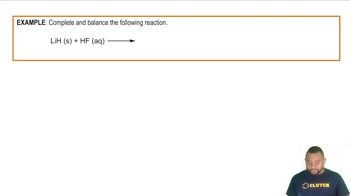
Production of Hydrogen Example

Stoichiometry in Equilibrium Expressions

The coefficients of the balanced chemical equation play a vital role in forming the equilibrium constant expression. For each species in the reaction, its concentration or pressure is raised to the power of its coefficient in the balanced equation. This stoichiometric relationship is essential for accurately calculating Kc and Kp, as it reflects the proportionality of the reactants and products at equilibrium.
추천 영상:
가이드 코스
03:20
Equilibrium Constant Expressions