
Ch.15 - Chemical Equilibrium
McMurry - Chemistry 8th Edition
McMurry8th EditionChemistryISBN: 9781292336145당신이 사용하는 게 아니라요?교과서 변경
15장, 문제 77

Which of the following reactions yield appreciable equilib- rium concentrations of both reactants and products? (a) 2 Cu1s2 + O21g2 ∆ 2 CuO1s2; Kc = 4 * 1045

검증된 단계별 안내
1
Identify the reaction and the given equilibrium constant (Kc). The reaction is: 2 Cu(s) + O2(g) → 2 CuO(s) and Kc = 4 * 10^45.
Understand the meaning of the equilibrium constant (Kc). It quantifies the ratio of the concentrations of products to reactants at equilibrium, raised to the power of their stoichiometric coefficients.
Analyze the magnitude of Kc. A very large Kc (e.g., 10^45) suggests that the reaction heavily favors the formation of products at equilibrium.
Consider the implications of a large Kc on the concentrations of reactants and products. Since Kc is extremely large, the concentration of reactants (Cu and O2) at equilibrium will be very low compared to the concentration of the product (CuO).
Conclude whether both reactants and products have appreciable concentrations at equilibrium. Given the very high value of Kc, it indicates that the concentrations of reactants will be negligible, thus not appreciable, at equilibrium.

비슷한 문제에 대한 검증된 영상 답변:

이 영상 해법은 위 문제에 도움이 된다고 튜터들이 추천한 것입니다.
영상 길이:
2m
도움이 되었나요?

주요 개념

질문에 올바르게 답하기 위해 반드시 이해해야 하는 핵심 개념들은 다음과 같습니다.

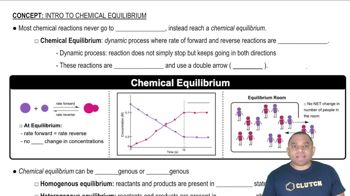
Chemical Equilibrium

Chemical equilibrium occurs when the rates of the forward and reverse reactions are equal, resulting in constant concentrations of reactants and products. At equilibrium, the system is dynamic, meaning that reactions continue to occur, but there is no net change in the concentrations. Understanding this concept is crucial for analyzing the extent to which a reaction proceeds and the conditions under which it reaches equilibrium.
추천 영상:
가이드 코스
04:21
Chemical Equilibrium Concepts

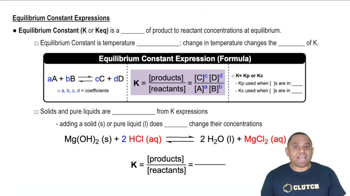
Equilibrium Constant (Kc)

The equilibrium constant (Kc) is a numerical value that expresses the ratio of the concentrations of products to reactants at equilibrium, each raised to the power of their coefficients in the balanced equation. A large Kc value, such as 4 * 10^45, indicates that at equilibrium, the concentration of products is much greater than that of reactants, suggesting that the reaction favors product formation. This concept helps predict the direction and extent of a reaction.
추천 영상:
가이드 코스
03:20
Equilibrium Constant Expressions

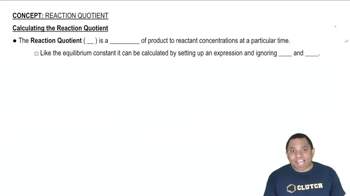
Reaction Quotient (Q)

The reaction quotient (Q) is a measure of the relative concentrations of reactants and products at any point in time, not just at equilibrium. By comparing Q to Kc, one can determine the direction in which a reaction will proceed to reach equilibrium. If Q < Kc, the reaction will shift to the right to produce more products; if Q > Kc, it will shift to the left to produce more reactants. This concept is essential for understanding how changes in conditions affect the position of equilibrium.
추천 영상:
가이드 코스
00:49
Reaction Quotient Q