
Ch.15 - Chemical Equilibrium
McMurry - Chemistry 8th Edition
McMurry8th EditionChemistryISBN: 9781292336145당신이 사용하는 게 아니라요?교과서 변경
15장, 문제 3

Given the data for the following reactions at 298 K: N2(g) + O2(g) ⇌ 2 NO(g) Kp = 4.4 * 10^-31 NO(g) + 1/2 O2(g) ⇌ NO2(g) Kp = 1.5 * 10^6, calculate the value of the equilibrium constant Kp at 298 K for the reaction N2(g) + 2 O2(g) ⇌ 2 NO2(g). (LO 15.3) (a) Kp = 6.6 * 10^-25 (b) Kp = 1.3 * 10^-24 (c) Kp = 9.9 * 10^-19 (d) Kp = 5.4 * 10^-28

검증된 단계별 안내
1
Step 1: Identify the target reaction: N2(g) + 2 O2(g) ⇌ 2 NO2(g).
Step 2: Recognize that the target reaction can be obtained by combining the given reactions: N2(g) + O2(g) ⇌ 2 NO(g) and NO(g) + 1/2 O2(g) ⇌ NO2(g).
Step 3: Reverse the first reaction to get 2 NO(g) ⇌ N2(g) + O2(g), which changes its Kp to 1/(4.4 * 10^-31).
Step 4: Multiply the second reaction by 2 to get 2 NO(g) + O2(g) ⇌ 2 NO2(g), which squares its Kp to (1.5 * 10^6)^2.
Step 5: Combine the modified reactions to form the target reaction and multiply their Kp values to find the Kp for the target reaction.

주요 개념

질문에 올바르게 답하기 위해 반드시 이해해야 하는 핵심 개념들은 다음과 같습니다.

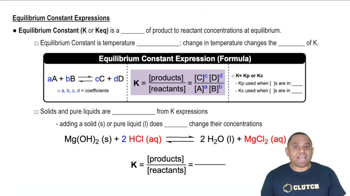
Equilibrium Constant (Kp)

The equilibrium constant (Kp) is a numerical value that expresses the ratio of the concentrations of products to reactants at equilibrium for a given reaction at a specific temperature. It is calculated using the partial pressures of gases involved in the reaction. A larger Kp indicates a greater tendency for products to form, while a smaller Kp suggests a preference for reactants.
추천 영상:
가이드 코스
03:20
Equilibrium Constant Expressions

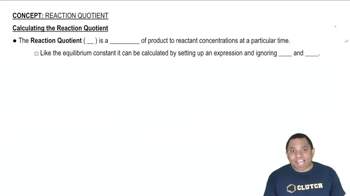
Reaction Quotient (Q)

The reaction quotient (Q) is a measure of the relative amounts of products and reactants present in a reaction at any point in time, not just at equilibrium. It is calculated in the same way as Kp but uses the current concentrations or partial pressures. Comparing Q to Kp helps determine the direction in which a reaction will proceed to reach equilibrium.
추천 영상:
가이드 코스
00:49
Reaction Quotient Q

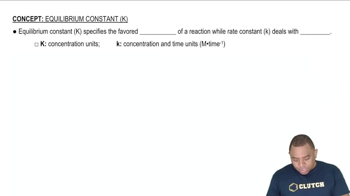
Manipulating Equilibrium Constants

When combining reactions to find the equilibrium constant for a new reaction, the equilibrium constants of the individual reactions can be manipulated. If a reaction is reversed, the equilibrium constant is inverted. If a reaction is multiplied by a coefficient, the equilibrium constant is raised to that power. This principle is essential for calculating Kp for complex reactions.
추천 영상:
가이드 코스
01:14
Equilibrium Constant K