
Ch.15 - Chemical Equilibrium
McMurry - Chemistry 8th Edition
McMurry8th EditionChemistryISBN: 9781292336145당신이 사용하는 게 아니라요?교과서 변경
15장, 문제 2

What is the equilibrium expression for the reaction of iron metal with water vapor? (LO 15.2 and 15.6) 2 Fe(s) + 3 H2O(g) ⇌ Fe2O3(s) + 3 H2(g)

검증된 단계별 안내
1
Identify the phases of each component in the reaction: Fe(s), H2O(g), Fe2O3(s), and H2(g).
Recall that the equilibrium expression, K, is written in terms of the concentrations of the gaseous and aqueous species only.
Write the general form of the equilibrium constant expression: K = [products]^coefficients / [reactants]^coefficients.
Since Fe(s) and Fe2O3(s) are solids, they do not appear in the equilibrium expression.
Write the equilibrium expression for the reaction: K = [H2]^3 / [H2O]^3.

주요 개념

질문에 올바르게 답하기 위해 반드시 이해해야 하는 핵심 개념들은 다음과 같습니다.

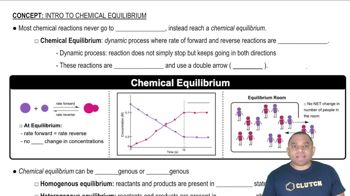
Chemical Equilibrium

Chemical equilibrium occurs when the rates of the forward and reverse reactions are equal, resulting in constant concentrations of reactants and products. In this state, the system is dynamic, meaning that reactions continue to occur, but there is no net change in the concentrations of substances involved.
추천 영상:
가이드 코스
04:21
Chemical Equilibrium Concepts

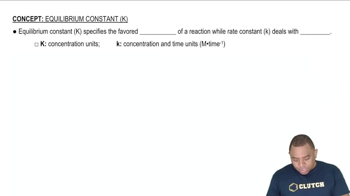
Equilibrium Constant (K)

The equilibrium constant (K) is a numerical value that expresses the ratio of the concentrations of products to reactants at equilibrium, each raised to the power of their coefficients in the balanced equation. For gaseous and aqueous species, K is calculated using molar concentrations, while solids and liquids are not included in the expression.
추천 영상:
가이드 코스
01:14
Equilibrium Constant K

Phase of Reactants and Products

In equilibrium expressions, only gases and aqueous solutions are included, while solids and pure liquids are omitted. This is because the concentration of solids and liquids does not change during the reaction, making their inclusion unnecessary for calculating the equilibrium constant.
추천 영상:
가이드 코스
00:53
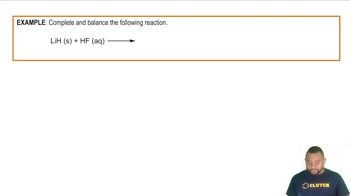
Production of Hydrogen Example