
Ch.15 - Chemical Equilibrium
McMurry - Chemistry 8th Edition
McMurry8th EditionChemistryISBN: 9781292336145당신이 사용하는 게 아니라요?교과서 변경
15장, 문제 82

Phosphine (PH3) decomposes at elevated temperatures, yielding gaseous P2 and H2: 2 PH3(g) ⇌ P2(g) + 3 H2(g), Kp = 398 at 873 K. (b) When a mixture of PH3, P2, and H2 comes to equilibrium at 873 K, P_P2 = 0.412 atm and P_H2 = 0.822 atm. What is P_PH3?

검증된 단계별 안내
1
Step 1: Write the expression for the equilibrium constant Kp for the reaction: Kp = (P_{P2} * (P_{H2})^3) / (P_{PH3})^2.
Step 2: Substitute the given values into the Kp expression: Kp = 398, P_{P2} = 0.412 atm, and P_{H2} = 0.822 atm.
Step 3: Rearrange the Kp expression to solve for P_{PH3}: (P_{PH3})^2 = (P_{P2} * (P_{H2})^3) / Kp.
Step 4: Substitute the known values into the rearranged equation: (P_{PH3})^2 = (0.412 * (0.822)^3) / 398.
Step 5: Solve for P_{PH3} by taking the square root of the result from Step 4.

주요 개념

질문에 올바르게 답하기 위해 반드시 이해해야 하는 핵심 개념들은 다음과 같습니다.

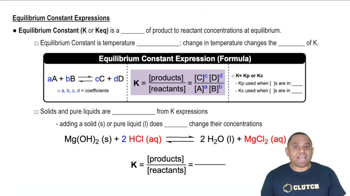
Equilibrium Constant (Kp)

The equilibrium constant (Kp) is a numerical value that expresses the ratio of the partial pressures of the products to the reactants at equilibrium for a given reaction at a specific temperature. For the reaction 2 PH3(g) ⇌ P2(g) + 3 H2(g), Kp is calculated using the formula Kp = (P_P2 * P_H2^3) / (P_PH3^2). Understanding Kp is essential for determining the concentrations or pressures of reactants and products at equilibrium.
추천 영상:
가이드 코스
03:20
Equilibrium Constant Expressions

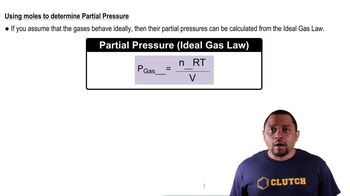
Partial Pressure

Partial pressure is the pressure exerted by a single component of a gas mixture. In the context of the given reaction, the partial pressures of PH3, P2, and H2 are crucial for calculating the equilibrium state. The total pressure of the gas mixture is the sum of the partial pressures, and knowing the partial pressures of the products allows us to find the partial pressure of the reactant PH3 using the equilibrium expression.
추천 영상:
가이드 코스
00:48
Partial Pressure Calculation

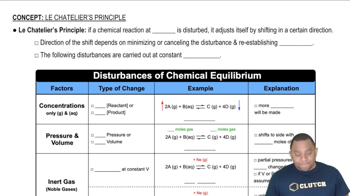
Le Chatelier's Principle

Le Chatelier's Principle states that if a dynamic equilibrium is disturbed by changing the conditions, the system will adjust to counteract the change and restore a new equilibrium. In this reaction, if the concentration of PH3 decreases or the temperature changes, the system will shift to either the left or right to re-establish equilibrium. This principle helps predict how changes in pressure, temperature, or concentration will affect the equilibrium position.
추천 영상:
가이드 코스
07:32
Le Chatelier's Principle