
Ch.15 - Chemical Equilibrium
McMurry - Chemistry 8th Edition
McMurry8th EditionChemistryISBN: 9781292336145당신이 사용하는 게 아니라요?교과서 변경
15장, 문제 146a

Refining petroleum involves cracking large hydrocarbon molecules into smaller, more volatile pieces. A simple example of hydrocarbon cracking is the gas-phase thermal decomposition of butane to give ethane and ethylene: (a) Write the equilibrium constant expressions for Kp and Kc.

검증된 단계별 안내
1
Identify the balanced chemical equation for the reaction. For the thermal decomposition of butane (C4H10) into ethane (C2H6) and ethylene (C2H4), the equation is: C4H10(g) → C2H6(g) + C2H4(g).
Write the expression for the equilibrium constant Kc using concentrations. Kc is defined as the product of the concentrations of the products raised to the power of their stoichiometric coefficients, divided by the product of the concentrations of the reactants raised to the power of their stoichiometric coefficients. For this reaction, it is: Kc = [C2H6][C2H4] / [C4H10].
Write the expression for the equilibrium constant Kp using partial pressures. Kp is similar to Kc but uses partial pressures instead of concentrations. The expression is: Kp = (PC2H6)(PC2H4) / (PC4H10).
Understand the relationship between Kp and Kc. They are related by the equation Kp = Kc(RT)^Δn, where R is the gas constant, T is the temperature in Kelvin, and Δn is the change in moles of gas (moles of products - moles of reactants). For this reaction, Δn = (1 + 1) - 1 = 1.
Apply the ideal gas law where necessary to convert between concentration and pressure if required, using the formula P = nRT/V, where P is the pressure, n is the number of moles, R is the gas constant, T is the temperature, and V is the volume.

비슷한 문제에 대한 검증된 영상 답변:

이 영상 해법은 위 문제에 도움이 된다고 튜터들이 추천한 것입니다.
영상 길이:
2m
도움이 되었나요?

주요 개념

질문에 올바르게 답하기 위해 반드시 이해해야 하는 핵심 개념들은 다음과 같습니다.

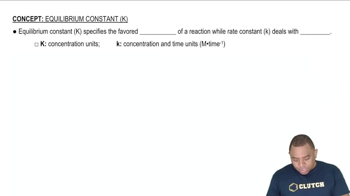
Equilibrium Constant (K)

The equilibrium constant (K) quantifies the ratio of the concentrations of products to reactants at equilibrium for a given reaction. For gaseous reactions, K<sub>p</sub> is expressed in terms of partial pressures, while K<sub>c</sub> is based on molar concentrations. Understanding how to derive these constants is essential for analyzing chemical reactions, particularly in the context of cracking hydrocarbons.
추천 영상:
가이드 코스
01:14
Equilibrium Constant K

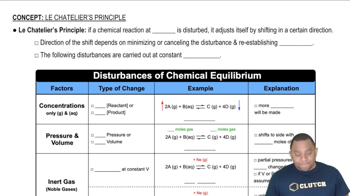
Le Chatelier's Principle

Le Chatelier's Principle states that if a dynamic equilibrium is disturbed by changing the conditions, the system will adjust to counteract the change and restore a new equilibrium. This principle is crucial in refining processes, as it helps predict how changes in temperature, pressure, or concentration will affect the yield of products like ethane and ethylene during hydrocarbon cracking.
추천 영상:
가이드 코스
07:32
Le Chatelier's Principle

Thermal Decomposition

Thermal decomposition is a chemical reaction where a compound breaks down into simpler substances when heated. In the context of hydrocarbon cracking, butane decomposes into smaller hydrocarbons, such as ethane and ethylene, under high temperatures. Understanding this process is vital for optimizing conditions in petroleum refining to maximize the production of desired volatile compounds.
추천 영상:
가이드 코스
02:35
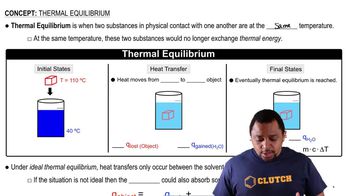
Thermal Equilibrium
관련 실천
교과서 질문

Refining petroleum involves cracking large hydrocarbon molecules into smaller, more volatile pieces. A simple example of hydrocarbon cracking is the gas-phase thermal decomposition of butane to give ethane and ethylene: (c) A sample of butane having a pressure of 50 atm is heated at 500 °C in a closed container at constant volume. When equilibrium is reached, what percentage of the butane has been converted to ethane and ethylene? What is the total pressure at equilibrium?

329
views
교과서 질문
At 1000 K, Kp = 2.1 * 106 and ΔH° = - 107.7 kJ for the reaction H21g2 + Br21g2 ∆ 2 HBr1g2. (b) For the equilibrium in part (a), each of the following changes will increase the equilibrium partial pressure of HBr. Choose the change that will cause the greatest increase in the pressure of HBr, and explain your choice. (ii) Adding 0.10 mol of Br2
486
views
교과서 질문
Heavy water, symbolized D2O 1D = 2H2 finds use as a neutron moderator in nuclear reactors. In a mixture with ordinary water, exchange of isotopes occurs according to the following equation: H2O + D2O ∆ 2 HDO Kc = 3.86 at 298 K When 1.00 mol of H2O is combined with 1.00 mol of D2O, what are the equilibrium amounts of H2O, D2O, and HDO (in moles) at 298 K? Assume the density of the mixture is constant at 1.05 g>cm3.
285
views
교과서 질문
Given the Arrhenius equation, k = Ae-Ea>RT, and the rela- tion between the equilibrium constant and the forward and reverse rate constants, Kc = kf>kr, explain why Kc for an exothermic reaction decreases with increasing temperature.
407
views
교과서 질문
Vinegar contains acetic acid, a weak acid that is partially dissociated in aqueous solution: CH3CO2H1aq2 ∆ H+ 1aq2 + CH3CO-1aq2 (b) What is the value of Kc if the extent of dissociation in 1.0 M CH3CO2H is 0.42%?
640
views