
Ch.15 - Chemical Equilibrium
McMurry - Chemistry 8th Edition
McMurry8th EditionChemistryISBN: 9781292336145당신이 사용하는 게 아니라요?교과서 변경
15장, 문제 146c

Refining petroleum involves cracking large hydrocarbon molecules into smaller, more volatile pieces. A simple example of hydrocarbon cracking is the gas-phase thermal decomposition of butane to give ethane and ethylene: (c) A sample of butane having a pressure of 50 atm is heated at 500 °C in a closed container at constant volume. When equilibrium is reached, what percentage of the butane has been converted to ethane and ethylene? What is the total pressure at equilibrium?

검증된 단계별 안내
1
Write the balanced chemical equation for the decomposition of butane: \[ \text{C}_4\text{H}_{10(g)} \rightarrow \text{C}_2\text{H}_{6(g)} + \text{C}_2\text{H}_{4(g)} \]
Define the initial conditions: Initial pressure of butane is 50 atm, and the initial pressures of ethane and ethylene are 0 atm.
Set up an ICE (Initial, Change, Equilibrium) table to track the changes in pressure for each species. Let 'x' be the change in pressure for butane that decomposes.
Express the equilibrium pressures in terms of 'x': \[ P_{\text{C}_4\text{H}_{10}} = 50 - x \], \[ P_{\text{C}_2\text{H}_6} = x \], \[ P_{\text{C}_2\text{H}_4} = x \].
Calculate the total pressure at equilibrium: \[ P_{\text{total}} = (50 - x) + x + x = 50 + x \].

비슷한 문제에 대한 검증된 영상 답변:

이 영상 해법은 위 문제에 도움이 된다고 튜터들이 추천한 것입니다.
영상 길이:
4m
도움이 되었나요?

주요 개념

질문에 올바르게 답하기 위해 반드시 이해해야 하는 핵심 개념들은 다음과 같습니다.

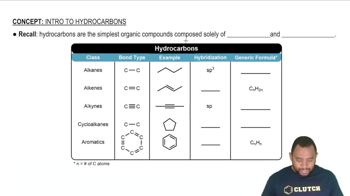
Hydrocarbon Cracking

Hydrocarbon cracking is a chemical process that breaks down large hydrocarbon molecules into smaller, more useful ones, typically through heat or catalysts. This process is essential in petroleum refining, as it increases the yield of lighter hydrocarbons like ethane and ethylene, which are valuable for fuel and chemical production. Understanding the mechanisms and products of cracking is crucial for predicting the outcomes of reactions involving hydrocarbons.
추천 영상:
가이드 코스
04:29
Intro To Hydrocarbons

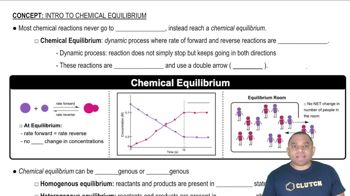
Equilibrium in Chemical Reactions

Chemical equilibrium occurs when the rates of the forward and reverse reactions are equal, resulting in constant concentrations of reactants and products over time. In the context of the butane cracking reaction, reaching equilibrium means that the amounts of butane, ethane, and ethylene will stabilize, allowing for the calculation of conversion percentages and total pressure. The concept of equilibrium is fundamental in predicting the behavior of reactions under specific conditions.
추천 영상:
가이드 코스
04:21
Chemical Equilibrium Concepts

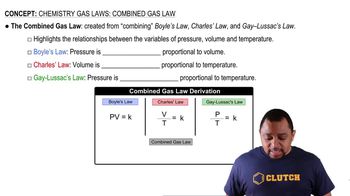
Gas Laws and Pressure Calculations

Gas laws describe the relationships between pressure, volume, temperature, and the number of moles of a gas. In this scenario, the ideal gas law (PV=nRT) can be applied to determine the total pressure at equilibrium after the reaction. Understanding how to manipulate these variables is essential for calculating the changes in pressure and volume that occur during the cracking process, especially in a closed system.
추천 영상:
가이드 코스
01:43
Combined Gas Law
관련 실천
교과서 질문

Refining petroleum involves cracking large hydrocarbon molecules into smaller, more volatile pieces. A simple example of hydrocarbon cracking is the gas-phase thermal decomposition of butane to give ethane and ethylene: (a) Write the equilibrium constant expressions for Kp and Kc.

322
views
교과서 질문
Halogen lamps are ordinary tungsten filament lamps in which the lamp bulb contains a small amount of a halogen (often bromine). At the high temperatures of the lamp, the halogens dissociate and exist as single atoms. (c) When the WBr41g2 diffuses back toward the filament, it decomposes, depositing tungsten back onto the fila- ment. Show quantitatively that the pressure of WBr4 from part (a) will cause the reaction in part (a) to go in reverse direction at 2800 K. [The pressure of Br1g2 is still 0.010 atm.] Thus, tungsten is continually recycled from the walls of the bulb back to the filament, allow-ing the bulb to last longer and burn brighter.
329
views
교과서 질문
At 1000 K, Kp = 2.1 * 106 and ΔH° = - 107.7 kJ for the reaction H21g2 + Br21g2 ∆ 2 HBr1g2. (b) For the equilibrium in part (a), each of the following changes will increase the equilibrium partial pressure of HBr. Choose the change that will cause the greatest increase in the pressure of HBr, and explain your choice. (ii) Adding 0.10 mol of Br2
486
views
교과서 질문
Heavy water, symbolized D2O 1D = 2H2 finds use as a neutron moderator in nuclear reactors. In a mixture with ordinary water, exchange of isotopes occurs according to the following equation: H2O + D2O ∆ 2 HDO Kc = 3.86 at 298 K When 1.00 mol of H2O is combined with 1.00 mol of D2O, what are the equilibrium amounts of H2O, D2O, and HDO (in moles) at 298 K? Assume the density of the mixture is constant at 1.05 g>cm3.
285
views
교과서 질문
Vinegar contains acetic acid, a weak acid that is partially dissociated in aqueous solution: CH3CO2H1aq2 ∆ H+ 1aq2 + CH3CO-1aq2 (b) What is the value of Kc if the extent of dissociation in 1.0 M CH3CO2H is 0.42%?
640
views