
Ch.15 - Chemical Equilibrium
McMurry - Chemistry 8th Edition
McMurry8th EditionChemistryISBN: 9781292336145당신이 사용하는 게 아니라요?교과서 변경
15장, 문제 111

The equilibrium constant Kc for the reaction N21g2 + 3 H21g2 ∆ 2 NH31g2 is 4.20 at 600 K. When a quantity of gaseous NH3 was placed in a 1.00-L reaction vessel at 600 K and the reaction was allowed to reach equilibrium, the vessel was found to contain 0.200 mol of N2. How many moles of NH3 were placed in the vessel?

검증된 단계별 안내
1
Step 1: Write down the balanced chemical equation. In this case, it is N2(g) + 3H2(g) ⇌ 2NH3(g).
Step 2: Write down the expression for the equilibrium constant Kc. For this reaction, it is Kc = [NH3]^2 / ([N2][H2]^3).
Step 3: From the problem, we know that at equilibrium, [N2] = 0.200 mol/L. We also know that Kc = 4.20. We can substitute these values into the Kc expression.
Step 4: We don't know the concentrations of NH3 and H2 at equilibrium, but we can express them in terms of changes from the initial conditions. Let's say that x moles of NH3 were initially present. Because the reaction consumes N2 and H2 to produce NH3, at equilibrium we have [NH3] = x - 2*[N2] and [H2] = 3*[N2].
Step 5: Substitute these expressions into the Kc expression and solve for x. This will give you the initial amount of NH3.

비슷한 문제에 대한 검증된 영상 답변:

이 영상 해법은 위 문제에 도움이 된다고 튜터들이 추천한 것입니다.
영상 길이:
3m

주요 개념

질문에 올바르게 답하기 위해 반드시 이해해야 하는 핵심 개념들은 다음과 같습니다.

Equilibrium Constant (Kc)

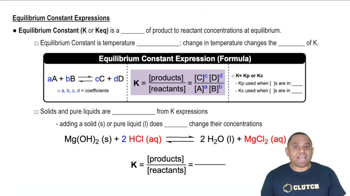
The equilibrium constant (Kc) is a numerical value that expresses the ratio of the concentrations of products to reactants at equilibrium for a given reaction at a specific temperature. For the reaction N2(g) + 3 H2(g) ⇌ 2 NH3(g), Kc = [NH3]^2 / ([N2][H2]^3). A Kc value greater than 1 indicates that at equilibrium, products are favored over reactants.
추천 영상:
가이드 코스
03:20
Equilibrium Constant Expressions

Stoichiometry

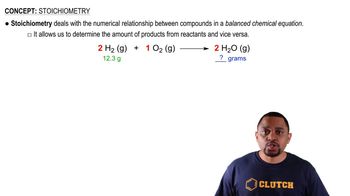
Stoichiometry involves the calculation of reactants and products in chemical reactions based on the balanced equation. In this case, the stoichiometric coefficients indicate that 1 mole of N2 reacts with 3 moles of H2 to produce 2 moles of NH3. Understanding stoichiometry is essential for determining the relationships between the amounts of substances involved in the reaction.
추천 영상:
가이드 코스
01:16
Stoichiometry Concept

Molarity and Concentration

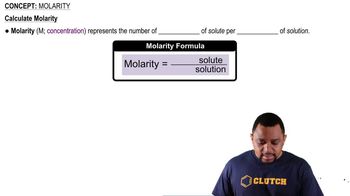
Molarity is a measure of concentration defined as the number of moles of solute per liter of solution. In this problem, the reaction occurs in a 1.00-L vessel, so the concentration of N2 can be directly equated to the number of moles present. This concept is crucial for calculating the equilibrium concentrations of all species involved in the reaction.
추천 영상:
가이드 코스
00:53
Molarity Concept