
교과서 질문
What is the pH and the principal source of H3O+ ions in 1.0 * 10-10 M HCl? (Hint: The pH of an acid solution can’t exceed 7.) What is the pH of 1.0 * 10-7 M HCl?
107
views

 검증된 단계별 안내
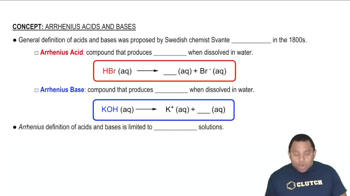
 02:00
02:00
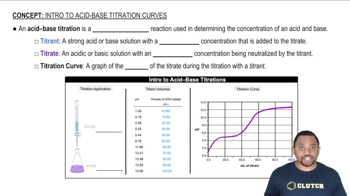 03:04
03:04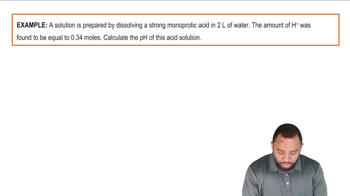 02:15
02:15What is the pH and the principal source of H3O+ ions in 1.0 * 10-10 M HCl? (Hint: The pH of an acid solution can’t exceed 7.) What is the pH of 1.0 * 10-7 M HCl?
The following pictures represent aqueous solutions of three acids HA1A = X, Y, or Z2; water molecules have been omitted for clarity.
(e) What is the percent dissociation in the solution of HZ?
The following pictures represent aqueous solutions of three acids HA1A = X, Y, or Z2; water molecules have been omitted for clarity.
(c) Which acid, if any, is a strong acid?
A 40.0 mL sample of a mixture of HCl and H3PO4 was titrated with 0.100 M NaOH. The first equivalence point was reached after 88.0 mL of base, and the second equivalence point was reached after 126.4 mL of base.
(e) Sketch the pH titration curve, and label the buffer regions and equivalence points.
Calculate the pH of solutions prepared by:
(d) Mixing equal volumes of 0.20 M HCl and 0.50 M HNO3.
(Assume that volumes are additive.)
The acidity of lemon juice is derived primarily from citric acid (H3Cit), a triprotic acid. What are the concentrations of H3Cit, H2Cit-, HCit2-, and Cit3- in a sample of lemon juice that has a pH of 2.37 and a total concentration of the four citrate-containing species of 0.350 M?