Ch.16 - Aqueous Equilibria: Acids & Bases
McMurry - Chemistry 8th Edition
McMurry8th EditionChemistryISBN: 9781292336145당신이 사용하는 게 아니라요?교과서 변경
16장, 문제 17.142

The acidity of lemon juice is derived primarily from citric acid (H3Cit), a triprotic acid. What are the concentrations of H3Cit, H2Cit-, HCit2-, and Cit3- in a sample of lemon juice that has a pH of 2.37 and a total concentration of the four citrate-containing species of 0.350 M?

검증된 단계별 안내
1
Identify the relevant acid dissociation constants (Ka) for citric acid (H3Cit). Citric acid is a triprotic acid, meaning it can donate three protons. The dissociation reactions are: H3Cit ightarrow H2Cit^- + H^+, H2Cit^- ightarrow HCit^{2-} + H^+, and HCit^{2-} ightarrow Cit^{3-} + H^+.
Write the expression for the pH of the solution and relate it to the concentration of H+ ions. Since pH = -log[H+], calculate [H+] using the pH given (2.37).
Set up the equilibrium expressions for each dissociation step using the Ka values and the concentrations of H3Cit, H2Cit-, HCit2-, and Cit3-. Use the formula Ka = [Products]/[Reactants] for each step.
Since the total concentration of all citrate species (H3Cit, H2Cit-, HCit2-, Cit3-) is given as 0.350 M, use this information to set up an equation summing the concentrations of all species to equal 0.350 M.
Solve the system of equations derived from the equilibrium expressions and the total concentration equation to find the individual concentrations of H3Cit, H2Cit-, HCit2-, and Cit3-.

비슷한 문제에 대한 검증된 영상 답변:

이 영상 해법은 위 문제에 도움이 된다고 튜터들이 추천한 것입니다.
영상 길이:
14m

주요 개념

질문에 올바르게 답하기 위해 반드시 이해해야 하는 핵심 개념들은 다음과 같습니다.

Triprotic Acids

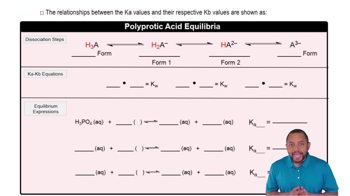
Triprotic acids, like citric acid, can donate three protons (H+) in a stepwise manner. Each deprotonation step has a distinct dissociation constant (Ka), which indicates the strength of the acid at each stage. Understanding the behavior of triprotic acids is crucial for calculating the concentrations of their various ionic forms in solution.
추천 영상:
가이드 코스
6:47
Triprotic Acid Equilibrium

pH and Concentration Relationship

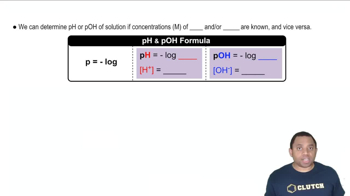
The pH of a solution is a measure of its hydrogen ion concentration, defined as pH = -log[H+]. In this case, a pH of 2.37 corresponds to a hydrogen ion concentration of approximately 0.0042 M. This relationship is essential for determining the concentrations of the different species of citric acid in lemon juice.
추천 영상:
가이드 코스
02:09
pH and pOH Calculations

Equilibrium and Species Concentration

In a solution containing a weak acid and its conjugate bases, the concentrations of the various species are determined by the acid dissociation equilibria. For citric acid, the total concentration of all species must equal the given total concentration (0.350 M), and the individual concentrations can be calculated using the equilibrium constants and the pH value.
추천 영상:
가이드 코스
03:03
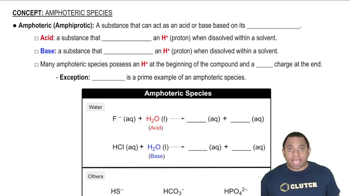
Amphoteric Species