Ch.16 - Aqueous Equilibria: Acids & Bases
McMurry - Chemistry 8th Edition
McMurry8th EditionChemistryISBN: 9781292336145당신이 사용하는 게 아니라요?교과서 변경
16장, 문제 159

A 200.0 mL sample of 0.350 M acetic acid (CH3CO2H) was allowed to react with 2.000 L of gaseous ammonia at 25 °C and a pressure of 650.8 mm Hg. Assuming no change in the volume of the solution, calculate the pH and the equilibrium concentrations of all species present (CH3CO2H, CH3CO2-, NH3, NH4+, H3O+, and OH-). Values of equilibrium constants are listed in Appendix C.

검증된 단계별 안내
1
Step 1: Calculate the initial moles of acetic acid (CH3CO2H) using its concentration and volume. Use the formula: \( \text{moles} = \text{concentration} \times \text{volume} \).
Step 2: Determine the moles of gaseous ammonia (NH3) using the ideal gas law, \( PV = nRT \), where \( P \) is the pressure, \( V \) is the volume, \( R \) is the ideal gas constant, and \( T \) is the temperature in Kelvin.
Step 3: Write the balanced chemical equation for the reaction between acetic acid and ammonia, and use stoichiometry to find the limiting reactant and the moles of products formed.
Step 4: Use the equilibrium constant expressions for the dissociation of acetic acid (\( K_a \)) and the ionization of ammonia (\( K_b \)) to set up equations for the equilibrium concentrations of all species.
Step 5: Solve the equilibrium expressions simultaneously to find the concentrations of \( \text{CH}_3\text{CO}_2^- \), \( \text{NH}_4^+ \), \( \text{H}_3\text{O}^+ \), and \( \text{OH}^- \). Use these to calculate the pH of the solution.

주요 개념

질문에 올바르게 답하기 위해 반드시 이해해야 하는 핵심 개념들은 다음과 같습니다.

Acid-Base Equilibria

Acid-base equilibria involve the transfer of protons (H+) between species in a solution. In this context, acetic acid (a weak acid) can donate a proton to ammonia (a weak base), forming acetate ions and ammonium ions. Understanding the equilibrium constant (Ka for acetic acid and Kb for ammonia) is crucial for calculating the concentrations of all species at equilibrium.
추천 영상:
가이드 코스
02:00
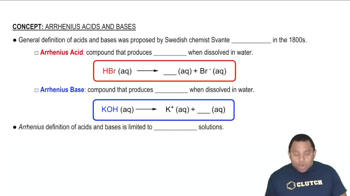
Arrhenius Acids and Bases

pH Calculation

pH is a measure of the hydrogen ion concentration in a solution, defined as pH = -log[H3O+]. To calculate the pH of the solution after the reaction, one must determine the concentration of hydronium ions (H3O+) at equilibrium. This involves using the equilibrium concentrations of the reactants and products, which can be derived from the initial concentrations and the changes that occur during the reaction.
추천 영상:
가이드 코스
02:15
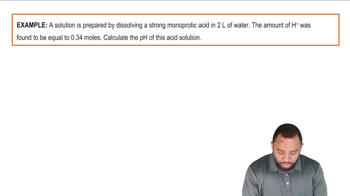
pH Calculation Example

Ideal Gas Law and Partial Pressure

The Ideal Gas Law (PV = nRT) relates the pressure, volume, and temperature of a gas to the number of moles. In this scenario, the gaseous ammonia's partial pressure must be converted to moles to determine its contribution to the reaction. Additionally, understanding how to calculate the concentration of gases in solution is essential for determining the equilibrium state of the system.
추천 영상:
가이드 코스
00:44
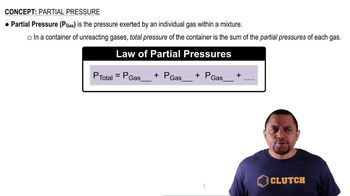
Law of Partial Pressures