Ch.16 - Aqueous Equilibria: Acids & Bases
McMurry - Chemistry 8th Edition
McMurry8th EditionChemistryISBN: 9781292336145당신이 사용하는 게 아니라요?교과서 변경
16장, 문제 160

You may have been told not to mix bleach and ammonia. The reason is that bleach (sodium hypochlorite) reacts with ammonia to produce toxic chloramines, such as NH2Cl. For example, in basic solution: OCl-1aq2 + NH31aq2S OH-1aq2 + NH2Cl1aq2 (b) The following mechanism has been proposed for this reaction in basic solution: H2O + OCl-HOCl + OH- Fast, equilibrium constantK1 HOCl + NH3 S H2O + NH2Cl Slow, rate constantk2 Assuming that the first step is in equilibrium and the second step is rate-determining, calculate the value of the rate constant k2 for the second step. Ka for HOCl is 3.5 * 10-8.

검증된 단계별 안내
1
Identify the rate-determining step in the mechanism, which is the second step: \( \text{HOCl} + \text{NH}_3 \rightarrow \text{H}_2\text{O} + \text{NH}_2\text{Cl} \).
Recognize that the rate law for the reaction is determined by the slow step. Therefore, the rate law is \( \text{Rate} = k_2 [\text{HOCl}][\text{NH}_3] \).
Use the equilibrium expression for the fast step to express \([\text{HOCl}]\) in terms of \([\text{OCl}^-]\) and \([\text{OH}^-]\): \( K_1 = \frac{[\text{HOCl}][\text{OH}^-]}{[\text{OCl}^-]} \).
Rearrange the equilibrium expression to solve for \([\text{HOCl}]\): \([\text{HOCl}] = K_1 \frac{[\text{OCl}^-]}{[\text{OH}^-]}\).
Substitute \([\text{HOCl}]\) from the equilibrium expression into the rate law to find \( k_2 \) in terms of known quantities.

비슷한 문제에 대한 검증된 영상 답변:

이 영상 해법은 위 문제에 도움이 된다고 튜터들이 추천한 것입니다.

주요 개념

질문에 올바르게 답하기 위해 반드시 이해해야 하는 핵심 개념들은 다음과 같습니다.

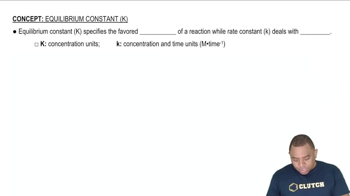
Equilibrium Constant (K)

The equilibrium constant (K) quantifies the ratio of the concentrations of products to reactants at equilibrium for a reversible reaction. It provides insight into the extent of a reaction and is temperature-dependent. In this context, K1 represents the equilibrium between hypochlorite ions and hypochlorous acid, indicating how much of each species is present when the reaction reaches a stable state.
추천 영상:
가이드 코스
01:14
Equilibrium Constant K

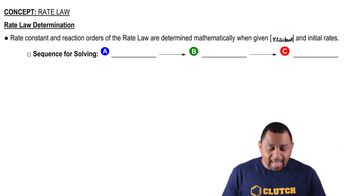
Rate-Determining Step

The rate-determining step is the slowest step in a reaction mechanism that dictates the overall reaction rate. In this case, the second step involving the reaction of hypochlorous acid with ammonia is the rate-determining step, meaning that its rate constant (k2) is crucial for calculating the overall reaction rate. Understanding this concept is essential for determining how changes in concentration affect the speed of the reaction.
추천 영상:
가이드 코스
01:15
Rate Law Determination

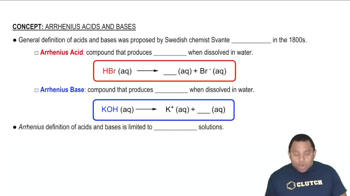
Acid-Base Equilibria

Acid-base equilibria involve the transfer of protons (H+) between species, influencing the concentrations of acids and their conjugate bases in solution. The dissociation constant (Ka) for hypochlorous acid (HOCl) indicates its strength as an acid. In this problem, knowing Ka helps in calculating the equilibrium concentrations of HOCl and its conjugate base, which are necessary for determining the rate constant k2 in the reaction mechanism.
추천 영상:
가이드 코스
02:00
Arrhenius Acids and Bases