
Ch.16 - Aqueous Equilibria: Acids & Bases
McMurry - Chemistry 8th Edition
McMurry8th EditionChemistryISBN: 9781292336145당신이 사용하는 게 아니라요?교과서 변경
16장, 문제 151

Acid and base behavior can be observed in solvents other than water. One commonly used solvent is dimethyl sulfoxide (DMSO), which can be treated as a monoprotic acid 'HSol.' Just as water can behave either as an acid or a base, so HSol can behave either as a Brønsted–Lowry acid or base. (b) The weak acid HCN has an acid dissociation constant Ka = 1.3 * 10-13 in the solvent HSol. If 0.010 mol of NaCN is dissolved in 1.00 L of HSol, what is the equilibrium concentration of H2Sol + ?

검증된 단계별 안내
1
Identify the species involved in the equilibrium: NaCN dissociates into Na+ and CN-. CN- can accept a proton from HSol, forming HCN and HSol-. The equilibrium reaction is CN- + HSol ⇌ HCN + HSol-.
Write the expression for the acid dissociation constant (Ka) for HCN in HSol: Ka = [H2Sol+][CN-] / [HCN].
Since NaCN is a salt of a weak acid (HCN), it will hydrolyze in the solvent HSol. Set up an ICE table (Initial, Change, Equilibrium) to track the concentrations of CN-, HCN, and H2Sol+.
Assume the initial concentration of CN- is 0.010 M, and the initial concentrations of HCN and H2Sol+ are 0. Use the ICE table to express the changes in concentration in terms of x, where x is the concentration of H2Sol+ at equilibrium.
Substitute the equilibrium concentrations from the ICE table into the Ka expression and solve for x, which represents the equilibrium concentration of H2Sol+.

비슷한 문제에 대한 검증된 영상 답변:

이 영상 해법은 위 문제에 도움이 된다고 튜터들이 추천한 것입니다.
영상 길이:
8m
도움이 되었나요?

주요 개념

질문에 올바르게 답하기 위해 반드시 이해해야 하는 핵심 개념들은 다음과 같습니다.

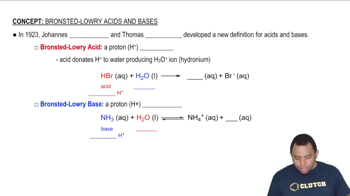
Brønsted–Lowry Acid-Base Theory

The Brønsted–Lowry theory defines acids as proton donors and bases as proton acceptors. This framework allows for the classification of substances based on their ability to donate or accept protons (H+ ions). In the context of the question, HSol can act as either an acid or a base, depending on the reaction conditions, similar to how water behaves.
추천 영상:
가이드 코스
02:08
Bronsted-Lowry Acid-Base Theory

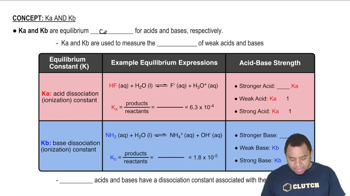
Acid Dissociation Constant (Ka)

The acid dissociation constant (Ka) quantifies the strength of an acid in a given solvent, representing the equilibrium between the undissociated acid and its ions. A lower Ka value indicates a weaker acid, as seen with HCN, which has a Ka of 1.3 × 10^-13 in HSol. This value is crucial for calculating the equilibrium concentrations of species in solution.
추천 영상:
가이드 코스
03:50
Characteristics of Ka and Kb

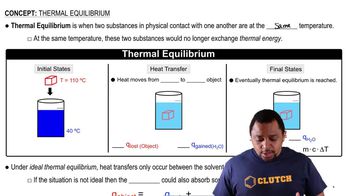
Equilibrium Concentration

Equilibrium concentration refers to the concentrations of reactants and products in a chemical reaction at equilibrium, where the rate of the forward reaction equals the rate of the reverse reaction. In this question, determining the equilibrium concentration of H2Sol+ involves applying the initial concentration of NaCN and the dissociation of HCN in HSol, using the provided Ka value to find the final concentrations.
추천 영상:
가이드 코스
02:35
Thermal Equilibrium